SEYMOUR JOHNSON AIR FORCE BASE, N.C. - The roar of departing fighter jets is the most powerful symbol of combat airpower at Seymour Johnson Air Force Base. However, long before an F-15E Strike Eagle taxis toward the runway, another mission unfolds quietly inside the Aircraft Parts Store.
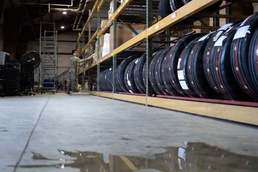
Behind warehouse doors and neatly stacked shelves, materiel management Airmen ensure every nut, bolt, tire and engine component is accounted for, tracked and ready for immediate issue. Their precision and speed directly determine how many aircraft the 4th Fighter Wing can generate each day, making these Airmen a critical link in delivering the wing’s promise of lethal, mission-ready airpower.
Inside the facility, more than 30 Airmen from several specialized elements sustain around-the-clock materiel support operations. They support dozens of F-15Es and KC-46A Pegasus aircraft from the 4th Fighter Wing and 916th Air Refueling Wing. Their work spans multiple warehouses and stockrooms housing over 16,000 line items with a combined value of approximately $100 million. This vast inventory ensures maintainers have immediate access to the parts required to keep aircraft mission ready.
“If it’s part of the aircraft, from the smallest pin to the engines, we have it,” said Staff Sgt. Shydaisia Gunn, 4th Logistics Readiness Squadron materiel management journeyman.
The team’s responsibilities extend beyond day-to-day warehouse operations. Airmen manage Mobility Readiness Spares Packages, commonly known as kits, valued at over $130 million. Composed of mission critical parts, these kits sustain aircraft during deployed and expeditionary operations. Personnel coordinate closely with Air Combat Command and Air Mobility Command to deploy and redeploy these assets, ensuring F-15E and KC-46A aircraft remain supported wherever global missions require them.
Airmen also use specialized logistics tracking systems to monitor inventory levels, document part histories and maintain accountability for millions of dollars in assets. Each transaction requires careful verification, matching hand receipts with stock numbers to guarantee the right component reaches the right maintainer at the right time. That behind-the-scenes precision directly influences flightline operations. Without timely supply support, maintainers cannot complete inspections or repairs, and aircraft remain grounded.
“Without us, none of those jets would get off the ground,” said Gunn.
Urgent requests highlight just how critical the mission can be. When another installation needed a mission capable asset immediately, waiting for standard shipping was not an option. Personnel drove to Seymour Johnson AFB to retrieve the part in person.
“They drove here to pick up a mission critical asset because they couldn’t wait,” said Gunn. “I handed it directly to them so they could fly.”
Moments like those reinforce the direct connection between warehouse operations and combat capability. Every issued component supports the 4th Fighter Wing’s ability to project airpower, train mission ready Airmen and respond to global taskings. Mobility Readiness Spares Packages ensure deployed forces maintain the same level of readiness abroad as they do at home station.
For Gunn, the mission carries deep personal meaning. Each time a Strike Eagle lifts into the sky, she sees the tangible result of her work.
“When I see an F-15 takeoff, I think about my daughter,” said Gunn. “Because I’m doing my job, they’re able to do theirs, and that helps keep her safe.”
The Aircraft Parts Store’s mission supports more than daily maintenance needs. Its overarching objective is to provide worldwide logistics support through the Aircraft Parts Store and enable rapid global mobility through the management of Mobility Readiness Spares Packages. Together, those efforts ensure combat airpower can be generated, sustained and projected whenever and wherever national defense requires it.
If the facility did not exist, flying operations would quickly grind to a halt. Aircraft could launch only a limited number of sorties before routine wear and unexpected maintenance demands outpaced available parts.
While pilots and maintainers often represent the visible edge of airpower, supply Airmen provide the foundation that makes every mission possible. Their work rarely draws attention, yet every successful sortie reflects their dedication to the mission.
As another Strike Eagle accelerates down the runway and climbs into the Carolina sky, its power represents more than advanced engineering and pilot skill. It reflects the quiet precision of supply professionals working behind the scenes, ensuring the 4th Fighter Wing remains ready to fly, fix and fight whenever the nation calls.