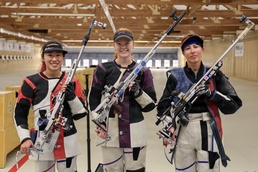
Four Soldiers with the U.S. Army Marksmanship Unit qualified to represent the United States at upcoming Rifle World Cups after competing in USA Shooting’s Spring Rifle Selection Match in Colorado Springs, Colorado, March 2–23.
The Soldiers competed alongside more than 100 of the nation’s top marksmen in the Olympic disciplines of 10-meter air rifle and 50-meter three-position rifle.
After relays and a final, the Fort Benning Soldiers earned spots on USA Shooting’s National Team, which will vie for medals at the International Shooting Sports Federation World Cups in Germany and China later this year.
In 10-meter air rifle, Staff Sgt. Brandon Muske and Sgt. Alison Weisz earned positions on the men’s and women’s teams, respectively. In 50-meter three-position rifle, commonly called smallbore, Sgt. Levi Clark and Staff Sgt. Sagen Maddalena qualified for the men’s and women’s teams.
Earning a World Cup berth is one step in a long training cycle, said Maddalena, who won the Silver Medal in Women’s 50-Meter Smallbore at the 2024 Paris Olympics.
“Now that I am on the National Team, my job is to prepare myself for the opportunities in these upcoming World Cups to make a podium spot,” she said.
Maddalena noted that training at this level involves more than the physical and technical challenges of repeatedly hitting a .5 mm target in 10-meter air rifle or a 10.4 mm target from 50 meters in smallbore.
“That preparation involves building up my mental game and regulating my emotions so that I am ready to compete with the best version of myself.”
The USAMU International Rifle Team’s long record of success shows that the most effective way to prepare for the pressure of international competition is to face it firsthand. So, earning opportunities to represent the nation at World Cups is not only an honor but also essential preparation for a potential run at the 2028 Olympics.
“These World Cups are very good for me to gain international experience and get used to matches that elevate my nerves more,” Clark said.
The Selection Match also marked the first competition using newly modified gear that complies with the ISSF’s 2026 rule changes—adjustments that required significant adaptation, Muske said.
“This selection match was difficult but rewarding. The training leading up to the match was not going especially well due to new equipment regulations.”
The ISSF changes require competitors’ canvas shooting suits to be substantially less rigid. Because ordering new custom-fit suits takes months, the Soldiers had to modify their existing gear. Some of the adjustments included removing one of the two layers, applying leather conditioner, and rolling the suits to break down the fibers, said Weisz, a 2020 Olympian in 10-meter air rifle.
“The team collectively spent hours and weeks modifying the suits to be legal,” she said.
Clark agreed that the new rules demanded extensive time and effort.
“We spent maybe a collective 100-plus hours modifying and testing our suits over and over again to find the best method that worked for us,” he said. “Then when we got to the match, we learned the temperature and humidity affected these tests, and we had to do further modifications.”
The extra work cut into training time, adding stress to match preparation, Muske said.
“I left Georgia feeling rather unprepared to perform but was able to execute my match plan effectively despite some of the physical deficiencies and less-than-ideal training leading up to the match.”
The ISSF changes affected all competitors, not just the Soldiers. Competitors shared modification techniques and discussed the added pressure of suit inspections, which could disqualify anyone whose gear failed to meet the new standards.
Suit changes weren’t the only shift at the Selection Match. This event was the first “one-and-done” selection match in years, Weisz said.
Under the previous system, competitors shot multiple matches, and the best five scores determined World Cup qualification.
“While that was challenging in its own right, this style brings on extreme intensity and pressure,” Weisz said. “You get two days and a final to perform and make your goal happen. I like to think I thrive under pressure, so it was exciting for me to compete like that again, but of course I was also nervous.”
Competition naturally brings anxiety, but adding suit inspections and a single-match selection format made the event especially stressful, she said.
“It was interesting watching everyone handle it differently. That really added a layer of challenge to maintain composure and not let other competitors’ emotions affect my own.”
Earning a World Cup slot not only provides international experience and medal opportunities but also helps athletes improve their world ranking—an important factor in gaining support from USA Shooting and the U.S. Olympic Committee, Weisz said.
“And the only way to get ranking points is attending these international competitions, so making the World Cup Team is incredibly valuable.”