Erin Cordrey is no stranger to seeing the majestic beauty of America’s mascot, the Bald Eagle, as a seasoned natural resource specialist.
That’s why she loves to share that experience with the faithful visitors of Harry S. Truman Lake — especially during Eagle Days.
“The wild bald eagles cooperated quite nicely by flying near the upper deck windows of the visitors center, putting on a perfect show,” she said. “Attendees of Eagle Days can sit in comfort and watch them live in their natural habitat.”
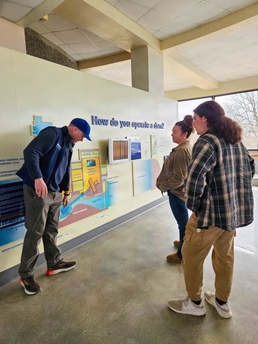
Sitting atop Kaysinger Bluff overlooking the dam and the natural beauty surrounding it, Harry S. Truman Lake’s Visitor Center is famous for its iconic views.
With some assistance from visual enhancers, Cordey said attendees also caught a glimpse of another illusive aspect of a wild bald eagle’s life.
“There are two active bald eagle nests visible from the visitor center’s observatory. [Here] volunteers equipped with binoculars and spotting scopes assisted visitors in watching these nests,” she said.
Eagle Days at Missouri’s largest federal reservoir is one of the Kansas City District, U.S. Army Corps of Engineers, premiere public events during the recreational off-season.
However, none of this would be possible without the lake’s role in protecting bald eagle habitats since its completion in 1979.
“The Grand Arm of Truman Lake had the distinction of being the first successful nesting location for the bald eagle in Missouri, following their dramatic decline into endangered status,” she said. “With the outlaw of DDT in 1972 and the abundance of waterfowl and fish available in the lake setting since, has provided habitat highly suited for bald eagles [to this day].”
The event was founded in the mid-1990s by former park ranger Dan Sandersfeld, and three decades later the mission remains the same — educating the public on the wildlife in the region, environmental stewardship and conservation efforts to protect the flora and fauna that call the lake home.
“From its inception, Eagle Days has been a sought-after and well-attended public outreach opportunity,” Cordrey said. “Attendance takes place in the January/February timeframe when bald eagles are most active in our area.”
According to Cordrey, the event set a new attendance record in 2024 with nearly 1,000 visitors.
However, two years later, the attendance for the 2026 event decreased somewhat due to weather conditions and the fact that Dickerson Park Zoo — an organization who has provided live eagle education programs for the event since 2000 — had to quickly change course because of the untimely deaths of ‘Phoenix’ the bald eagle and ‘Aquila’ the golden eagle, due to illnesses associated with old age nearly a month before the event.
Despite these crowd favorites not being there any longer, the number of people who showed up in 2026 was still impressive.
“This year’s event brought in over 400 people,” she said. “Some [came] from as far away as northeast Illinois and were eager to soak in the rare chance to come really close to live birds of prey.”
To supplement the loss, the Harry S. Truman Lake project office and Dickerson Park Zoo sprang into action to find viable replacements that would astonish the crowd in a safe educational setting.
Although Cordrey acknowledged attendees expressed sadness about the losses of Dickerson Park Zoo’s ambassador eagles, she said their disappointment was quickly quelled by the new stars of the show.
“The zoo’s volunteer docents brought 'Suli' the turkey vulture, 'Sky' the peregrine falcon, 'Scout' the American kestrel, 'Fred' the screech owl and 'Silo' the barn owl. They were equally delighted at the opportunity to learn about these other amazing birds of prey,” she said.
The new birds of prey weren’t the only highlight of the day either.
Other collaborators for the event included the Missouri Department of Conservation, who provided volunteers and educational materials for the crowd to learn about Missouri’s black bear population; the Missouri Master Naturalists of Cole Camp; Connie the Snake Lady; and local high school, Lincoln, which showed off their student collection of eagle artwork.
Collectively, Cordrey said their interactive, informational exhibits kept both the kids and adults captivated.
“Connie the Snake Lady [brought] six of her snakes for people to touch and learn about, and they spent the day dissecting an owl pellet with [the Missouri Master Naturalist chapter],” she said. “Here, visitors could see rodent bones and just how beneficial birds of prey are, and they brought some tasty edible insects for visitors to try out.”
Not to be outdone, Kansas City District park rangers that patrol the vast grounds of Harry S. Truman Lake used the opportunity to promote water safety before the start of the highly anticipated recreation season.
“Our water safety booth gave information about [proper] life jacket wear and hypothermia,” she said.
In the eyes of Cordrey and her colleagues, the 2026 Harry S. Truman Lake Eagle Days event was a resounding success, and they can’t wait to continue the storied tradition next year.
“It’s very rewarding for the lake project office because of its focus on wildlife education, outdoor skills, water safety and how to get involved in conservation and environmental stewardship programs,” she said. “Attendees are always in awe of the live birds, snakes, edible insects and the many other aspects of lake life that the [USACE] stands for. We thank all our partners and volunteers. Without them this event would not be possible.”