Imagine waking up in an unfamiliar place potentially thousands of miles from home. Here, you’re surrounded mostly by strangers in a dormitory-style dwelling, along with experiencing some new sights or smells.
For the average American civilian who may have experienced college but not the intricacies associated with daily military life, the scenario sounds more like a scene from infamous movies about life on a university campus such as “Animal House” or “Legally Blonde,” not something you would find on a military base in a big city or small town.
However, this is often the experience for many junior enlisted soldiers when they enter military service unmarried. So, like the average college dormitory, many of the living quarters on U.S. Army Base Fort Riley in central Kansas have seen better days — since they have been occupied by tens of thousands of soldiers since they were commissioned almost three decades ago.
That’s why behind the doors of a quad of highly trafficked barracks at one of the U.S. Army’s premier training commands, a transformation is underway — one that is reshaping how junior enlisted soldiers live, train and prepare for their missions, according to project engineer Clayton Plummer.
“These spaces are designed to give soldiers a comfortable place to live so they can focus on their mission,” Plummer said, who works out of the Fort Riley Resident Office in the Kansas City District, U.S. Army Corps of Engineers. “At the end of the day, it’s about providing a better environment for them.”
Unseen obstacles behind the walls and with entryways
Originally constructed around the turn of the 21st century, the barracks conditions had deteriorated to a point where it was time for upgrades to meet today’s living standards.
Kicking off in November 2023, project plans called for sweeping renovations to four three-story buildings with 60 rooms each, where crews were tasked with stripping interiors down to structural framework to install updated mechanical systems and individual living quarters, per the U.S. Army’s Whole Building Design Guide.
But what began as routine barracks renovations quickly revealed some hidden challenges once contractors began to dig deeper into the structures. According to Plummer, who began working on the project when he transferred to the Fort Riley office in 2024, what they found became the most significant issue he’s faced since taking the lead from the previous project manager.
“They found mold in the walls, and thankfully it wasn't horrible, but it was something that needed to be dealt with because it obviously risked the life, safety and health of our soldiers,” Plummer said. “When you do renovations, there’s always something you discover once you open the walls.”
After checking plumbing and other water systems for leaks to only come up empty, he said the likely culprit for mold to spread in different living quarters throughout the building was water vapor and condensation.
So, this invisible flow of water droplets that built up over time and spread from the windowsills to the walls, wasn't caused by any design flaw, but the innocuous actions of junior enlisted soldiers going through the daily challenges inherent to surviving U.S. Army training.
“Previous occupants would accidentally leave windows [cracked] during deployments or open over the weekend, and when storms came, that’s how water got in,” Plummer said.
The next surprise arrived not from a temporary lapse of memory but from blueprints drafted during the original design phase of the barracks complex — a period when the United States was flirting with transitioning from the domestic customary units of measurement to the international metric system, according to Plummer.
What they found when crews started installing new doors was every doorway in all four buildings was slightly smaller than standard U.S. measurements.
“The specifications for doorways called for 36 inches [in width], that’s typical for the Whole Building Design Guide. These doors measured out at like 35 and three-eighths inches … which was kind of confusing,” he said. “Finally, we dug enough and found these buildings were designed and built around 2000 ... they're 90-centimeter doors when you do the metric conversion.”
Rather than attempting to modify all the buildings in the barracks complex — a task that would’ve required more time and a hefty cost increase — Plummer and his team adjusted their renovation plans to accommodate the metric dimensions for doors from the original blueprints.
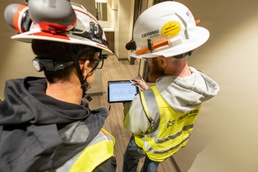
Construction on the barracks complex has sometimes involved a large workforce as well. At peak activity, as many as 80 to 90 workers were on site daily who represented multiple trades.
Blake Hinson is a lead superintendent with Cerris Builders, the prime contractor in charge of overseeing all subcontractors and their construction efforts on the renovation project. He said managing schedules and coordinating the different trades has been key to keeping the project flowing smoothly and efficiently.
“It’s about making sure everything is ready before the next activity starts,” he said. “You learn quickly that timing and coordination make a big difference.”
This is also where quality assurance comes into play since it is another critical component for all USACE projects. Plummer said there is a three-phase inspection process to ensure all work meets strict standards — with initial inspections verifying installation methods, follow-up checks monitoring contractor progress and the final inspections focused on the finished product.
“All inspections are really about the details. We go through and do spot checks on everything so it's not all done at once on the final inspection,” he said.
For Hinson, he said he appreciates the thoroughness of USACE processes as a first-time lead.
“Overall, working with the USACE has been good … they make it pretty efficient,” he said. “It’s been a good learning experience [since] it’s something new to learn every day. You try to take the lessons learned and apply them in situations where you can do better.”
Improving soldiers’ lives through community partnership
For the soldiers who will one day call these barracks home, the renovations underway represent more than construction but reflect a commitment to better living conditions, where comfort and functionality for occupants are at the forefront.
“A lot of it is a morale thing, you know, to help the soldiers out. So, it's meant to look nice,” Plummer said. With that vision in mind, all four barracks buildings have an improved single room and shared suite room layout that includes many modern amenities.
“They have a kitchenette with an electric two-burner cooktop and tiled bathrooms that are shared, but they each have their own sink outside of the shower itself. They also have luxury vinyl tile flooring throughout, and each soldier has their own walk-in closet,” Plummer said.
Beyond improving living conditions for soldiers in the renovation, Plummer said that each building has seen a significant facelift outside of the living quarters as well.
“We installed new [Carrier] HVAC systems, upgraded electrical and data infrastructure, installed new plumbing, made repairs to many of the windows and added new concrete walkways for each building,” he said.
Another caveat of the renovation project highlights the role of public-private partnerships in the Kansas City District’s military construction mission as well.
Scott Fagan is a site safety and health officer for Cerris Builders. As someone who has worked on federal projects for half of his 30-year career in construction, he said the nature of federal builds helps ensure accountability while supporting collaboration between the federal government and the contractors they hire.
“Once you get used to the structure, it actually sets everyone up for success,” Fagan said. With federal projects, it's a little more black and white than the private [sector] world and the owners who can sometimes be difficult to deal with or whatnot.”
The project also provides a boost to local communities surrounding Fort Riley. Many subcontractors and their workers are based in nearby cities such as Manhattan and Junction City. This means federal investment in the installation directly supports the bottom lines of businesses nearby.
“I grew up in Manhattan [so] I know the kind of large impact that Fort Riley has on the economy,” Fagan said.
As the project nears its schedule completion date of August 2026, one of four of the buildings is completely done. Nearing the finish line, project leaders said the finished barracks will reflect years of coordination, problem-solving and attention to detail — all aimed at delivering a better living environment for the soldiers who call Fort Riley home.
“It’s an honor to contribute in some way to making sure our soldiers have good accommodations,” Fagan said.