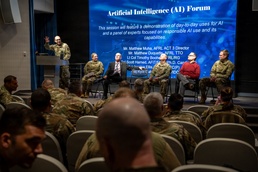
A 911th Airlift Wing officer who spends her civilian career architecting AI governance solutions helped organize one of the Air Force Reserve's largest annual training events — one where artificial intelligence sat at the center of the agenda.
Maj. Jessica Ellis, a medical corps officer with the 911th Aeromedical Staging Squadron and innovation officer at Pittsburgh International Airport Air Reserve Station, co-organized the Spring 2026 Common Training Assembly alongside Capt. Jeremiah Williams of Air Force Materiel Command. The multi-day event, held at the Air Force Institute of Technology Feb. 25, 2026, drew 90 Individual Mobilization Augmentees and senior leaders from AFMC, the National Air and Space Intelligence Center, and the 445th Airlift Wing.
In her civilian role, Ellis is an AI Solution Architect at Booz Allen Hamilton, where she focuses on AI governance, human-computer interaction, and risk management frameworks. She also spent the past year serving as a handpicked advisor and experimentalist in AI and autonomy for the Integrated Capabilities Command (Provisional), the Air Force organization activated in September 2024 to accelerate force modernization and unify requirements development against pacing threats.
That combination of civilian expertise and operational experience made her a natural fit to help steer an assembly where AI readiness was a primary topic of discussion.
"It brings the Reservists in the area together to discuss all of the organizational policy changes, the implications and continued readiness," Ellis said. "This is my first year planning it and we started planning it about six months ago."
The assembly centered on three priorities shaping the evolving Reserve force: organizational restructuring, integration of emerging technology, and professional development. Attendees received briefings on artificial intelligence, readiness, and the Air Force Reserve's roles, missions and strategic impact — all under the theme "Fostering Warrior Culture."
Among the senior leaders who addressed the assembly were Maj. Gen. Mark V. Slominski, the mobilization assistant to the commander of AFMC, and Brig. Gen. Christopher J. Hobbs, the mobilization assistant to the commander of the Air Force Life Cycle Management Center.
Hobbs emphasized the event's value in keeping a geographically dispersed force aligned.
"We review policy changes and items of interest," Hobbs said. "It's great to get everyone together and make sure everyone is on the same page and talk about opportunities moving forward."
Slominski addressed the growing strategic weight Reserve Airmen carry in the total force.
"We're essential to the fight," Slominski said. "There's been a growing evolution over the last number of decades in which the reservists and guardsmen [were] viewed as sort of ancillary, but relevant. But now it's absolutely integral to the fight."
The assembly concluded at the National Museum of the U.S. Air Force, where participants explored exhibits on the Korean and Southeast Asian conflicts — eras that defined the Reserve's growth from a 1948 organization into the mission-ready partner it is today.
For Slominski, the assembly captures something fundamental about the Citizen-Airman model.
"For me, the neat thing about being a Citizen Airman is that it allows you to effectively balance yourself, your family, your military service and your civilian service," Slominski said. "I think it's the blending of all those things."
The strategic priorities established during the assembly will guide IMAs through the remainder of the year — another example of Steel Airmen bringing capability to the fight that extends well beyond Pittsburgh, strengthening the total force from the hangar floor to the halls where the Air Force's future is being decided.