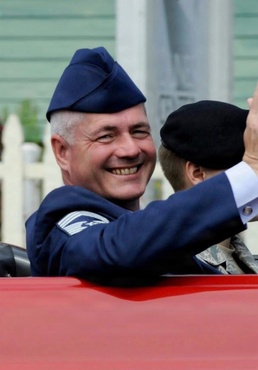
On January 13, 2026, Retired Chief Master Sgt. Pat Abbott lost his courageous battle with cancer. For those who knew him, he was a man of quiet intelligence, subtle humor, and unshakable composure. Whether leading 500-person squadrons in contested environments or meticulously mastering a new hobby, he lived by a simple motto: “Make it different, make it better.” His recent passing has left a void in the hearts of many, but his legacy as a phenomenal leader, friend, and mentor endures.
As the son of a soldier, Abbott was an “Army brat” familiar with the rhythms of military life from a young age. He began his own military journey in 1984, deciding to enlist in the Air Force. The recruiter’s advice led to a spontaneous proposal to his now wife, Lisa. They were married just a week later, beginning a lifelong partnership months before he officially started his service that October.
Those who knew him best say the character he showed in uniform was the same one he carried into his home and everyday life. His wife reflected on the man she first met working at a grocery store in 1983, remembering that even then he carried the same calm confidence and humor that would come to define his leadership. “He was always smiling… always kept a happy demeanor and had a wicked sense of humor,” she said.
Abbott’s impact was rooted in his deep experience as both a civil engineer and a leader. Jerry Lewis, who succeeded Abbott as Chief of Enlisted Matters at the Pentagon in 2011, highlighted the depth of his technical expertise. “He had spent his entire career doing CE work – site surveying, AutoCAD, and a lot more,” Lewis said.
Karl Deutsch, a long-time professional peer and friend, first worked with Abbott during one of his most defining roles, when he served as Squadron Superintendent for the 820th RED HORSE Squadron from 2005 to 2008. “He was a phenomenal leader who led 500-plus RED HORSE teams,” Deutsch said. “They were all over the AOR – Iraq, Afghanistan – in some pretty contested and dangerous situations.” Leading at that scale required navigating constant complexity across distance and risk.
Even in that environment, Abbott’s defining trait was steadiness, reinforcing trust and clarity when it mattered most. “I never saw him get anxious or upset,” Deutsch recalled. “He always seemed to have a level attitude, no matter what the situation was.”
Abbott’s sense of purpose showed up in how he led from the front. While senior enlisted leaders typically step away from hands-on roles, Lewis pointed to Abbott’s deep operational grounding. “He was very passionate about RED HORSE,” Lewis said. Abbott wasn’t removed from the mission: he belonged to it. "He was really good at what he did.”
Lisa echoed this sentiment, saying Abbott’s passion defined how he spoke about service throughout his career. “After 30 years, he never had anything bad to say about the Air Force,” she said. “[Civil Engineering] was definitely his niche."
Abbott’s impact extended beyond deployed leadership to the enterprise level. In 2008, he moved into the Pentagon as Civil Engineers continued to deploy at high rates, focusing his efforts on readiness across the force. “Pat really took it upon himself to make sure engineers across the globe were trained, organized and equipped,” Lewis said, calling it “his biggest, most significant accomplishment.”
For those deploying at the height of the surge during Operation Iraqi Freedom and Enduring Freedom, the ops tempo came at a real personal cost. Alfredo Perez, who first met Chief Abbott in 2005 at Nellis Air Force Base when Abbott became his Senior Enlisted Leader at the 820th RED HORSE Squadron, described the reality many engineers faced.
“Engineers would have a one- or two-to-one dwell, and sometimes even a one-to-one,” Perez said. “That meant within a 12-month period, you were deployed for six to seven months, plus about a month of pre-deployment training. When you factor in another three to four months supporting a New Horizons mission in South America, you were gone for most of the year, only home for a short window in between.” When engineers returned home, support systems were limited. Perez recalled transitioning back to normal life with little to “no type of support.”
Recognizing that mission readiness depended on people, Perez recalled how Abbott responded with action, advocating for systems that gave Airmen time and space to reset before returning home. “He was a key advocate to ensuring that engineers were coming back and able to reintegrate with their families in a successful way,” Perez said.
Abbott’s people-first mindset defined his leadership at every level. “He knew when you take care of the people, the people will take care of the mission,” Lewis said. When institutional barriers arose, Abbott refused to stop at the first obstacle. “You get told no a lot because something had never been done before,” Lewis said. “Pat would never accept that as an answer. He would always find a way to get to yes,” doing so deliberately, Lewis added. Abbott’s instinct to help others succeed extended far beyond the workplace. Mentorship, Lisa reflected, was central to how Abbott approached both service and leadership. “He always wanted to be a friend and a mentor,” she said. “He really wanted to serve young airmen and women.”
Beyond the uniform, Abbott brought the same curiosity and quiet intensity to everything he pursued. Whatever Abbott took on, “he became an expert and was all the way in it,” Deutsch said, recalling Abbott’s deep knowledge of interests ranging from wine to the Hoover Dam. He also remembered Abbott’s understated humor as “very subtle, but hilarious” and his habit of “poking the bear” just enough to keep people sharp. Abbott was also an avid Call of Duty player, using his “chief USAF” gamertag to connect with his son and his friends across locations and time zones.
Lewis remembered Abbott as someone who never sought recognition. “He didn’t need big crowds, or pomp and circumstance,” he said. What mattered were relationships and presence. “He was a fun person to be around,” Lewis added, noting that Abbott “would always find the positive in every single situation.”
After retiring from the Air Force, Abbott began a new chapter at the company Amentum, where his coworkers recalled the same leadership style that had defined his time in uniform. Audry Batiste described him as a natural leader who could “solve any problem thrown his way” while motivating others to pursue the same goal. “I will miss Pat,” she stated simply.
Former coworker Daniel Pepper recalled how Abbott consistently led by example, ensuring those around him were prepared to execute the mission while remaining “humble, credible, and approachable.” Kathleen Sadler added that he led his teams with “firm, fair, and consistent” professionalism and made a point of sharing his knowledge so others could continue the mission after him. “He was a valiant fighter to the very end,” Sadler said.
Chief Abbott’s legacy isn’t measured by rank or title, but by the people and standards he left behind. His example endures in the engineers he prepared and the Airmen he advocated for. His most cherished legacy, however, lives on in his family: his wife, three children, and his five grandchildren.
Abbott proved that credibility comes from knowing the work, that leadership requires steadiness in the hardest moments, and that taking care of people is inseparable from mission success. Long after the deployments, policies, and positions have passed, his example endures – in the engineers he prepared, the Airmen he advocated for, and the leaders who now carry forward his simple standard: make it different, make it better.