ABERDEEN PROVING GROUND, Md. – “The integration and synchronization between what you do, and the broader cyber community, is something that I want to learn about,” Lt. Gen. Chris Mohan, the commanding general of U.S. Army Materiel Command, said while opening the U.S. Army Communications-Electronics Command quarterly Army Transformation Initiative update brief.
Keeping that desire in mind, CECOM senior leaders provided command updates to Mohan March 31, 2026, at Tobyhanna Army Depot, Pennsylvania.
The updates centered on delivering Command, Control, Communications, Computers, Cyber, Intelligence, Surveillance, and Reconnaissance-Medical integration and sustainment for Army-wide readiness; strengthening the organic industrial base; and empowering a future readiness workforce.
Harnessing Artificial Intelligence to Revolutionize Readiness
A central theme throughout the brief was the transformative power of AI that CECOM is embedding into its core processes to dramatically improve efficiency.
The Army Software & Integration Center demonstrated its AI Assisted Help Desk, an agentic AI that assists enterprise help desks with advanced problem-solving support to users and agents developed at ASIC.
“We have a very small sample size through the roll out, but we are projecting a 20% reduction in ticket volume and cycle time, and a 20% increase in the ticket resolution rate,” Garrett Shoemaker, the director of ASIC, said. “To give context, we have supported approximately 9,000 tickets in a three-month period.”
Abel Salgado, the acting director of the Integrated Logistics Support Center, introduced the Publishing, Authoring, and Review Assistant, or PARA, tool, which provides end-to-end assurance checks through all phases of the technical manual writing development process.
“PARA is an AI-enabled tool that provides technical writers a suite of capabilities centralized in one location to execute publications a lot faster and more efficiently,” Salgado said. “For example, if a technical writer is working on a manual, PARA accelerates and automates tedious military standard formatting, allowing writers to focus on quality of content while ensuring Soldiers get what they need faster.”
Forging a Modernized Organic Industrial Base
A core pillar of CECOM transformation is leading the charge in modernizing the Army OIB by moving to create resilient, forward-thinking facilities.
Col. Mathew Miller, the commander of U.S. Army Information Systems Engineering Command, detailed its push to deliver cyber resilience across Army installations, effectively creating interconnected installations that will function as sentient fortresses.
“We’re an execution agent to standardize modernization across the OIB,” Miller said. “Our engineers make sure that the infrastructure that we’re laying, or any of the other sensoring that is needed, is standard. We’re trying to map installation resiliency through water, fuel, electric, things like that, and utilize that data in a dashboard to create a standardized tool for commanders.”
This proactive approach extends to the Army Medical Logistics Command as well through its efforts to strengthen the medical sustainment ecosystem through the Forward Repair Activity-Medical initiative, which brings critical maintenance expertise to units without organic biomedical equipment maintainers.
The initiative bridges a long-standing readiness gap caused by the costly and time-consuming process of shipping devices to AMLC’s Medical Maintenance Operations Divisions, or MMODs, for sustainment-level support. FRA-M has supplied maintenance coverage to more than 1,200 units across more than 18,600 devices.
The success of these modernization efforts across the command was underscored by Mohan, who pointed to Tobyhanna Army Depot as a tangible example of what sustained investment and a comprehensive strategy can achieve.
“I talk about TYAD as our most modernized depot,” Mohan said. “I purposely send people here to see TYAD as I send them to another place that has not had the sustained investment in facilities that TYAD has had to show the difference between organizations. The future is bright for you; I look forward to seeing what is happening next.”
Closing Comments
In his closing remarks, Mohan called for a strategic shift in how the Army views CECOM not merely as a support command in broad transformation efforts, but as a leader in innovation through its advancements in AI, small uncrewed aircraft systems, depot modernization and cyber resilience.
“We have to put CECOM on the map, because it’s not just the rapid acquisition that is happening,” Mohan said. “We need to figure out how to make CECOM synonymous with a center of excellence. We need to get to a point where people come to you and say, ‘I need to solve a problem, and you have the resources to do that.’”
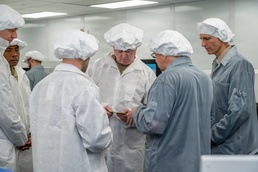
Mohan toured the modernized facilities at TYAD following the brief.