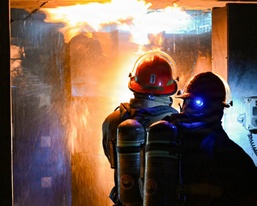
Deep within a state-of-the-art training structure, flames roll overhead and steam billows out of open doors. A team of senior Navy Damage Controlmen, clad in full firefighting ensembles, moves with disciplined aggression toward the roaring heart of the blaze. They aren't just fighting a fire; they are learning the elite firefighting skills necessary to combat the most serious of shipboard fires.
This is the reality of the new Elite Firefighting Course at Surface Warfare Schools Command (SWSC) Learning Site Bangor, a rigorous two-week program developed to forge the next generation of shipboard firefighting experts.
Born from the hard-learned lessons of devastating shipboard fires like the USS Bonhomme Richard (LHD 6) and USS Miami (SSN 755), the course was created to address a critical gap in training: how to combat a large, out-of-control, fully developed fire at sea.
"A lot of this came from shortfalls that we found when it came to the USS Miami Fire and the USS Bonhomme Richard Fire,” said James Bauer, the Director of Training at the fire school and a 20-year Damage Controlman veteran. “When we talk about fully developed fires, most Sailors don't know what to do in those situations because it's not readily trained. It was the first time that pretty much anyone on that vessel had ever seen it before."
The course, which satisfies Level IV of shipboard survivability training requirements outlined in OPNAVINST 3541.1, dives deep into the complexities of fire dynamics and the command and control of a multi-team response. Sailors tackle scenarios rarely encountered outside of a real-world disaster, including battery locker fires, volatile Otto fuel (a highly flammable torpedo propellant), and incidents involving compressed gasses.
"We realized that there were a lot of deficiencies in advanced firefighting tactics,” said Chief Damage Controlman Sarah Spangle, the noncommissioned officer-in-charge of the learning site. “This school was made to address those deficiencies and give Sailors the training and practical application they need to take back to the Fleet and ensure that things such as the Bonhomme Richard don't happen again."
A unique strength of the program is its instructor cadre, composed almost entirely of active or retired civilian firefighters. These seasoned professionals bring decades and, collectively, hundreds of years of real-world experience to the training environment.
"In the civilian world, we don't practice firefighting with flags. It's live fire training," said Bauer. "My staff members are on one to two fires a month. They bring a level of technical knowledge and practical application that the Navy doesn't really get to see."
This blend of civilian experience and naval doctrine creates a powerful learning environment.
Students learned to read the quality of smoke, understand the neutral plane in a burning compartment, and manage the immense heat and energy of a fully developed fire—dangers most Sailors have only read about, Bauer said.
The training was intensely realistic.
"They get touched by fire," Spangle said, "which really helps the students understand that they can trust their firefighting gear, that it will protect them."
This confidence is critical. Bauer emphasized that building trust in their equipment removes a significant layer of stress, allowing firefighters to be more aggressive and effective.
"Firefighting is scary," Bauer said. "And anyone who tells you that it's not scary hasn't been in a real fire before. When you can put a Sailor in that environment in a very controlled way and show them their gear works, you can take that one piece of the stress out of the puzzle."
The course curriculum is comprehensive, covering both offensive and defensive firefighting strategies as well as advanced techniques for rescuing personnel from hazardous, confined spaces. The hands-on training for forcible entry is particularly critical, giving Sailors experience with specialized rescue equipment.
Students learned to master tools like the Portable Exothermic Cutting Unit (PECU), a specialized torch that uses a powerful chemical reaction to burn through a ship's metal structures like doors and bulkheads. This allows teams to create an escape or entry path where one has been blocked by damage. They also trained with the Portable Electric-powered All-purpose Rescue Set (PEARS), a set of powerful hydraulic tools often called the "Jaws of Life," which can pry open jammed doors, cut through metal, and lift heavy objects to free a trapped Sailor.
Beyond the hands-on tactics, a significant portion of the training focuses on high-level coordination through the National Incident Management System (NIMS). This ensures Sailors can integrate their response with external agencies, a critical component of managing a large-scale fire in port, as simulated in the complex 8010 drill. Ultimately, the goal of this intense training is to ensure that when the next major fire happens, Sailors have the expert-level knowledge to handle it, preventing another catastrophic loss. This starts by fundamentally changing how senior firefighters perceive their surroundings and potential dangers.
"Our goal is that when they go back to their ship, when they walk into a compartment and they see a bag of trash, they don't see a bag of trash anymore, they see a fuel source," Bauer said.
By arming these leaders with advanced knowledge and the confidence to act decisively under extreme pressure, the Elite Firefighting Course is not just training Sailors; it is strengthening the Fleet's resilience and ensuring that when the alarm sounds, the Navy's firefighters are ready to conquer the flames and save the ship.