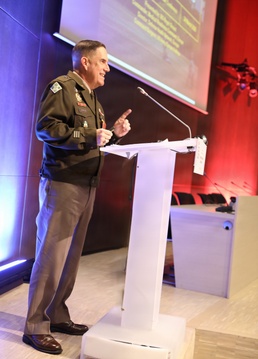
PARIS – More than 200 senior NATO medical leaders from across Europe gathered in Paris on Tuesday, Mar. 24, for a symposium hosted by the French Armed Forces Medical Service. The intent of the symposium was to address the urgent need for adapting allied military health services to meet the realities of high-intensity or large- scale combat operations (LSCO).
The medical symposium, attended by military medical leaders from France, Germany, Spain, and the United States provided a critical platform for senior military medical leaders to share knowledge, discuss innovative medical strategies, and enhance interoperability among allied forces. The central theme of the symposium was the adaptation of military health services in the face of a major military engagement.
Individuals responsible for planning the symposium stated that for decades, the prevailing assumption was that a large-scale, high-intensity conflict in Europe was unlikely. However, recent geopolitical events have invalidated this assumption, compelling allied nations to reassess and reinforce their medical readiness.
Among the guest speakers at the symposium was U.S. Army Brig. Gen. Roger Giraud, commander of Medical Readiness Command, Europe and command surgeon for U.S. Army Europe and Africa. During his remarks to the assembly, Giraud emphasized the gravity of the current security landscape in Europe.
"We gather here today to speak about the important topic of warfighting," Giraud said. "For three decades, Europe nations assumed that a high-intensity conflict on the European continent was improbable. Well, this assumption is not valid."
Among the topics discussed at the symposium were practical measures to ensure that military medical services can effectively support a large-scale combat operation, from point of injury care to strategic medical evacuation.
“The collaboration taking place this week between the participating nations aims to build a more resilient and integrated military medical system, capable of meeting the challenges of high-intensity conflict,” added Giraud. “Integration of NATO nations health service plans is essential to overcoming contested logistics, clearing the battlefield and optimizing return to duty.”
Military medical experts indicate that when LSCO happens, medical systems become a strategic determinant of endurance, legitimacy, and enable success on the battlefield. The insights discussed during the symposium were intended to inform and shape the future of military medical readiness across the continent.
"Medical readiness is not only about the conduct of war, but also about deterring war," said Giraud. "Deterrence fails when endurance fails. Medical readiness is endurance."
According to senior military medical leaders, in a high-intensity conflict involving peer adversaries, casualty volumes within days would be of scope and scale not seen since the World Wars of the last century.
“Medical success in large-scale combat operations will be a coalition success,” added Giraud. "Stronger together is not just a slogan. To be truly stronger, we must act in three decisive ways; maintain medical readiness for crisis response, drive medical transformation and accelerate NATO medical integration.”
At the conclusion of the symposium, the consensus among attendees was unanimous; medical resilience underwrites deterrence, integrated multinational care sustains combat power, and endurance enables global deterrence.