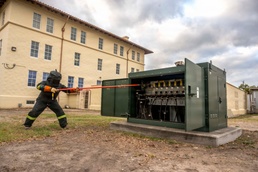
**JOINT BASE SAN ANTONIO, Texas –**Joint Base San Antonio recently concluded a large-scale emergency preparedness drill, the ENERGY RESILIENCY Response Exercise, designed to test and strengthen its ability to respond to a regional crisis. The exercise, which ran from March 23-27, simulated a complex, multi-day catastrophic event to ensure JBSA can protect its people and continue its mission under the most challenging conditions.
The scenario involved a hypothetical, widespread wildfirethatcaused power outages across the installation lasting for several days.One focus of the exercise was to overcome modern technological dependencies. According to U.S. Air Force Staff Sgt. Veronica Mollema, 502nd Air Base Wing Inspector General exercise coordinator, one of the goals was to emphasize teamwork. She explained the scenario forced units to answer the critical question of: How will we communicate when faced with no phones, no computers, and no internet. Wing Inspection Teamobservers on the groundwere tasked with evaluating how units responded to these challenges.
"We are observers who ought to be able to check on the ins and outs of service-related activities within the exercise, to see how they react to the different scenarios," said Sean Yoder, an 802nd Force Support Squadron Military and Family Readiness Center coordinator serving as a WIT member.
Both Yoder and his WIT partner, George Romero, a 502d Force Support Group operations specialist, witnessed a powerful example of creative problem-solving. Romero said they observed a moment when a unit’s leadership, once informed that all modern communications were down, immediately developed a low-tech solution to maintain contact.
Romero said it wasa highlight for him,as a WIT observer,to see military members think on their feet and come up with a plan.
The exercise also tested dependencies on modern infrastructure.
Yoder noted how the scenario revealed unexpected challenges when automated systems suddenly became unavailable, as the scenario forced a widespread return to non-digital methods.
"You start to find that we have to go back to basics," Yoder said.
"By doing this exercise, it really, I think, it brought people together to see, 'Okay, what is really mission-essential here,'"he continued."From my perspective, people got creative, you know, and it worked."
By simulating a worst-case scenario, the exercise provided invaluable data for JBSA’s emergency managers and leadership.
The lessons learned will be used to refine and enhance emergency response plans, ensuring JBSAis building a resilient installation capable of withstanding and recovering from any challenge and maintains mission continuity in the face of any threat.
(For operational security reasons, specifics will not be published.)