Fleet Readiness Center Southwest’s (FRCSW) mission is to deliver combat ready aircraft and components to the United States Navy and Marine Corps warfighter so they can fight and win in any battle.
While much of the spotlight often falls on the artisans and engineers who repair and overhaul aircraft, there are other highly specialized teams working behind the scenes whose impact is just as critical to mission success. One such team is the Chemical Handlers of the FRCSW Environmental Department.
Every aircraft and component that enters FRCSW follows a complex journey. Components are removed, inspected, cleaned, treated, and restored through a series of highly controlled processes before being returned to service. These processes depend on a network of specialized systems, tanks used for cleaning, coating, and restoration. In order to perform their jobs these tanks must be precisely maintained to exact standards.
The FRCSW chemical handlers, with direction from the commands Materials Laboratory engineers, are the professionals who execute this work with precision, consistency, and discipline. Their role is to maintain the integrity of these systems so that artisans can perform their work without interruption.
Read more about the scientific backbone guiding this effort here: FRCSW Materials Lab
The work this team performs requires extensive training, certification, and strict adherence to protocols. Every task is carefully coordinated to ensure that operations are conducted efficiently and responsibly. They communicate closely with production personnel, clear work areas before beginning tasks, and ensure all work is verified and documented before systems return to service. This disciplined approach protects personnel, preserves equipment, and ensures continuity of operations.
Working in close coordination with the Mat Lab, Chemical Handlers carefully manage the composition, timing, and environmental conditions required for each process. They respond to Chemical Action Requests (CARs) generated by the Materials Lab, performing precise adjustments that keep processing systems within required parameters. Their work ensures that every component moving through FRCSW meets the standards required for operational use. Without this team, command production would slow and ultimately stop.
This work demands extraordinary attention to detail. It is not simply a matter of adding or removing substances, it involves understanding how variables such as timing, temperature, and sequencing affect outcomes. Every action must be executed correctly the first time to ensure both efficiency and continuity across the production floor while at the same time ensuring all employees, the chemical handlers included, are safe.
Once work is completed, the team coordinates closely with shop supervisors and the Materials Lab to verify that systems are ready for use. This layered approach ensures quality, accountability, and safety at every step.
FRCSW operates around the clock, and so does its Chemical Handlers team. They maintain a 24/7 operational posture, ensuring that no matter when production demands arise, support is always available.
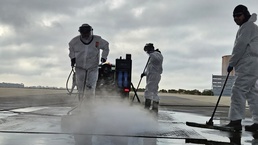
Their impact extends beyond processing tanks. At the test line, they maintain critical support systems that keep aircraft operations running smoothly. This includes servicing oil pumping stations, maintaining clean and ready aircraft pads, and ensuring that key infrastructure remains operational.
Chemical Handlers are not only maintainers, but they are also innovators. A prime example is the implementation of an industrial high-powered pressure washer recycling system. Recognizing the need to improve efficiency and reduce strain on the aging infrastructure at the test line, the team adopted this mobile system to clean aircraft pads more effectively before residue could enter existing capture systems.
The results have been remarkable. Residual buildup has been significantly reduced, operational efficiency has improved, and the solution has delivered the desired results at a substantial cost savings.
FRCSW Executive Officer, CAPT Shannon Thompson, has highlighted this system as a model of smart, mission-focused innovation.
“The team identified a potential issue, took a proactive approach to solving it & came up with a solution that had minimal cost & a large impact. That’s awesome work by our incredible Patriots!” – CAPT Shannon Thompson, FRCSW Executive Officer
The importance of the Chemical Handlers team is perhaps most evident when considering the broader operational flow at FRCSW. “All roads lead to paint” is a common phrase at the command. Aircraft must pass through washing and preparation stages before final coatings can be applied. Chemical Handlers also manage critical systems that support this phase of maintenance.
Despite operating at reduced staffing levels, currently about 33% below authorized strength, the Chemical Handler team continues to meet and exceed expectations. In fiscal year 2025 alone, they:
· Completed 526 service requests from production shops · Executed 223 Chemical Action Requests from the Materials Laboratory · Supported a 23% increase in workload compared to the previous year
The team has done this while maintaining strict adherence to safety and environmental standards, and through a variety of yearly inspections from various regulatory bodies, all with outstanding results. These achievements reflect not only technical expertise, but also a deep commitment to the FRCSW mission.
At its core, the work of FRCSW supports a larger purpose: defending the nation and enabling the warfighter. Chemical Handlers play a vital role in that mission. By ensuring the systems that support aircraft repair are fully operational, they directly contribute to the readiness and reliability of the U.S. military.
The contributions of the FRCSW Chemical Handlers team may not always be visible, but their impact is undeniable. They are essential to the success of the command. Their dedication, expertise, and relentless commitment to excellence ensure that FRCSW continues to deliver on its promise to the fleet.
FRCSW employees are the Backbone of Military Readiness!