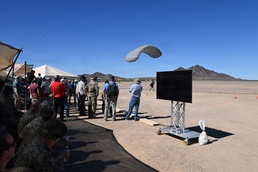
U.S. Army Yuma Proving Ground’s Yuma Test Center (YTC) demonstrated the most cutting-edge developments of the U.S. Army Combat Capabilities Development Command Soldier Center (DEVCOM SC) for an entire week in March.
More than 300 participants from the United States and 11 different partner nations attended the event, necessitating a massive effort by YTC personnel to accommodate the visitors.
“At least 100 people at YPG have played a role in planning or executing this mission,” said Edgar Hurtado, Air Delivery Branch Team Lead. “There are a couple of technologies that we are seeing for the first time, but really we wanted to showcase this to the U.S. and partner nations,”
The wide array of cutting-edge cargo and personnel parachute technologies brought a significant number of personnel from the airdrop community together in one place to exchange ideas. Virtually all of these systems have undergone extensive testing at YPG, or will be soon, particularly in the realm of powered cargo systems. “There are a lot of aerial denial capabilities by adversary forces,” said Hurtado. “When we have forces within an aerial denial bubble, it gets hard to resupply them with ammo, food, water, and equipment. The idea is to drop something outside of that bubble and have that powered system fly into there and resupply our troops with accuracy.”
Personnel parachutes were an important aspect of the demonstration as well.
“We’ve been working on a project for interoperability between the U.S. T-11 main parachute and the European A400M transport plane,” said Hurtado. “For this big test week, we invited a lot of international partners to showcase the interoperability that we already have. The Army already has safety confirmations for the Low Velocity Airdrop System platforms for heavy equipment like vehicles and fuel blivets and Container Delivery System that often contains food, ammo, and water.”
“We’re in the middle of making a new update to the T-11 personnel parachute,” added Lt. Col. Kevin Hicks, YTC Commander. “We demonstrated a mass tactical exit of an aircraft on two days. We have glide modifications, long-range GPS-guided delivery packages: you name it, we have it.”
Yet YPG’s size alone does not account for its elite standing in the air delivery community: While other ranges might have the air space to conduct an event like this, they are not specifically designed to do it with the infrastructure and standard operating procedures to coordinate multiple sorties safely.
“We have a one kilometer by seven kilometer drop zone that doesn’t exist anywhere else in the country,” said Ross Gwynn, YPG Technical Director. “All of the instrumentation coupled with that can collect all the data testers need in an experiment. Within the decelerator community, YPG is at the tip of the spear in advancing those capabilities and providing the performance data that they need to continue iterating.”
The demonstration site consisted of a set of bleachers under an awning and several large tents, all overlooking an immensely desolate drop zone bordered by distant mountains. As each system was demonstrated, narrators addressed the crowd over a loudspeaker. With multiple sorties per day, each with multiple airdrop passes, spectators did not want for parachute action. The event provided a prime opportunity for engineers and military officers from different allied nations to discuss the state-of-the-art technology, both for inspiration and to avoid unnecessary duplication of existing ideas.
“This demonstration is really showcasing where the Army is moving when it comes to contested and congested logistics,” said Hicks. “It’s ensuring we’re putting out the best kit to the warfighters that we can.”