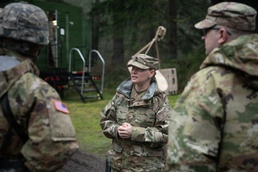
In the dark, before the first candidates step onto the lanes and before the day’s chaos begins to take shape, Master Sgt. Ericka Thompson is already moving.
It starts at 5 a.m. A quiet check of personnel. Lane walkers. Opposing forces. Making sure every piece is in place before anyone else even realizes the machine is turning. By 0600, she is linking up with squads, watching lanes come to life, and ensuring that what happens on the ground matches what was planned. Left hand talking to the right hand. Always.
Most candidates will never see that part.
Candidates arrive on day one of Officer Candidate School Phase III in full sprint. They have spent the last 9 months going through Phases I and II with their home states and have made it to the culminating event. It’s time to prove they have what it takes to be an officer for the United States Army. Once boots hit the ground, the 13-day clock till graduation starts.
Layouts. Headshots. Medical. Chaos.
What they will see is the pressure. The movement. The friction of Officer Candidate School Phase III. What they will not see is the network behind it all, the constant adjustments, the unseen effort that keeps training from breaking down.
For the past two years, that responsibility has rested with Thompson.
“In my 20-something years in the Army, both Active Duty and in the National Guard, she is hands down the best NCO I’ve ever worked with,” said Capt. Dunkley, OCS commander.
Thompson’s path to that reputation was not built overnight. A native of Gig Harbor, Washington, she served on Active Duty from 2005 to 2015 as a military police officer before continuing her career in the Washington Army National Guard. Over time, she became a fixture within OCS Phase III, spending four years as an instructor before stepping into the role of first sergeant for the situational training exercise (STX) lanes.
Last year, that role expanded even further.
In 2025, opposing forces and lane walkers were consolidated into a single unit, forming STX Company, a 36-person team responsible for executing some of the most demanding training in the course. Thompson now oversees not just those elements, but the broader support structure that makes training possible. From coordinating personnel to setting up tents, building out the tactical operations center, and handling the constant stream of “hey, you” tasks, her influence stretches far beyond what her title suggests.
“I think for my role now as first sergeant for STX lanes, I tend to do more because I know what the cadre need to make their lives easier,” Thompson said. “I can use my knowledge of both roles.”
That perspective did not come easily.
“When you are an instructor during OCS, and specifically Phase III, you are always out on the lanes, and you have almost zero visibility to what all the support staff is doing,” she said. “Until being a part of support staff, I never realized how much they do to get the mission completed.”
It is that understanding that allows her to anticipate problems before they happen, filling gaps before they are even noticed.
Still, for Thompson, the most meaningful moments are not found in logistics or planning. They are found in people.
“I selfishly like the instructor side of it,” she said. “I love the face-to-face contact with the candidates where I feel like you have the highest impact on people’s lives and careers.”
One moment in particular stands out.
After spending three years on Active Duty as a drill instructor, Thompson returned to OCS years later, where one of the instructors recognized her as their former drill sergeant.
“To see it all come full circle will always be a memorable moment,” she said. “Those are the rewarding things.”
That sense of impact extends beyond the lanes and into the formation as a whole. Whether in uniform or in her civilian career managing a risk portfolio for Wells Fargo, Thompson emphasizes the importance of showing up and being known.
“Be where you’re supposed to be when you’re supposed to be there, and things will fall into place,” she said. “And if that time comes and you’re ETSing, then maybe it’s time. But I feel like most often people realize the community they are going to lose. Be where you’re supposed to be, when you need to be there, and keep moving forward.”
She carries that same mindset into her civilian work.
“Go out and tell your story,” she said. “Regardless of your level in an organization or here in the Guard, everyone has different value and skill sets that they can bring to the team, all of which can easily be overlooked if people don’t know you. Make sure your organization knows who you are.”
Now, after more than two decades of service, Thompson is preparing to step away from the Army.
“It’s very bittersweet,” she said. “If it weren’t for my civilian job, I would stay way longer.”
That job opportunity will take her across the country, marking the first time she has seriously considered leaving the military.
“I’ve never even considered leaving the Army until I received this job offer,” she said. “It’s a good time for me to prioritize my civilian life.”
Her departure will leave a gap that cannot easily be filled. Long before the first formation and long after the final lane is complete, leaders like Thompson are the ones ensuring everything in between holds together. Most people will never see that work. When she’s gone, the lanes will still run, but everyone will feel what’s missing.