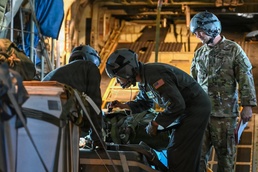
__LITTLE ROCK AIR FORCE BASE, Ark. __— The C-130H Hercules, the tactical airlift workhorse of the U.S. Air Force, is undergoing a significant transformation through the Avionics Modernization Program to ensure its continued relevance and global mission capability well into the 21st century.
At the center of the effort to systematically upgrade the legacy H-model fleet is a combined test force composed of Air Force Reserve and Air National Guard personnel with the host 417th Test and Evaluation Squadron. This collaboration draws on each unit's deep institutional knowledge and commitment to the C-130H to ensure global mission capability well into the 21st century.
Current efforts include retaining six multifunction displays in a revised configuration with ergonomic hand controls and preserves both the flight engineer and navigator positions, maintaining critical crew redundancy for the tactical airlift mission.
At its core, the Avionics Modernization Program replaces aging analog systems with integrated digital avionics, enhancing navigation and communication capabilities while addressing the diminishing availability of parts for legacy components, which have increasingly restricted fleet access to regulated international airspace.
Lt. Col. Eric Dueno, director of the C-130 Combined Test Force overseeing the modernization program, emphasized the necessity of the upgrades.
“This effort is essential to maintaining the C-130H’s operational relevance and ensuring it can execute its global mission set without restriction,” Dueno said.
Dueno said the program is not merely implementing minor upgrades but is “fundamentally modernizing these aircraft to meet current and future airspace requirements worldwide.”
A key component of the Avionics Modernization Program is the integration of a new flight management system, transitioning aircrews from the hands-on flexibility of legacy analog controls to the structured navigation input methods characteristic of modern airliners. Crews have rapidly increased proficiency through consistent operational flights and focused training.
Operational testing and evaluation are conducted by the Combined Test Force, whose shared institutional knowledge of the C-130H platform positions them to evaluate Avionics Modernization Program upgrades in demanding, operationally realistic conditions before full fleet implementation. That partnership reflects a broader total force commitment to ensuring the Hercules remains capable and relevant for every community that flies it.
Lt. Col. Andy “DAT” Kraemer, who oversees aspects of Combined Test Force testing, said the team remains focused on the aircrew experience.
“At the operational level, our focus is on the user experience,” Kraemer said. “We evaluate how these systems perform for aircrews in demanding tactical airlift environments.”
Jeff Thelander, an employee with the Aircraft Airlift Test Center with more than 40 years of experience supporting the C-130 platform, said the shift represents a complete cockpit overhaul.
“We have essentially transitioned from a completely analog cockpit to a fully digital environment,” Thelander said. “These upgrades are non-negotiable. They are the assurance that the C-130H will continue to deliver personnel and cargo precisely where they are needed, anywhere in the world.”
As the Avionics Modernization Program progresses toward key acquisition decisions and full fleet implementation, it reinforces the C-130H Hercules as a long-term asset that will support tactical airlift and global readiness for decades to come.