Keith Yuen, a supervisory engineer at Naval Air Warfare Center Weapons Division spent years building a jammer designed to defeat America’s own radars. The harder his team made it for friendly pilots to see through the jamming, the better they were doing their job.
Then the question changed: what if the same system could jam the enemy?
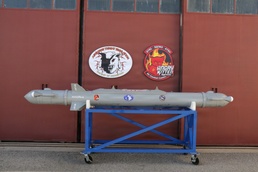
The system is Angry Kitten, an electronic warfare pod that NAWCWD engineers integrated and matured over a decade. Built to simulate hostile jamming during training, it is now headed to contested airspace as an offensive weapon, giving pilots a proven, government-owned jammer to suppress enemy air defenses.
That transformation spans three military services and a partnership between NAWCWD and Georgia Tech Research Institute that began with one requirement: the Air Force needed better threat pods.
In 2013, aggressor squadrons at Nellis Air Force Base, Nevada, needed advanced jamming pods to create realistic electronic warfare environments during training. Georgia Tech Research Institute had developed Angry Kitten’s core technology. The Air Force needed a team to package it into a flyable, maintainable pod system.
They chose NAWCWD’s Airborne Threat Simulation Organization. The organization had spent decades building and fielding threat simulation jammers for Navy and Air Force training ranges, working directly with intelligence agencies to replicate the electronic warfare environments U.S. pilots would face in combat.
Its engineers brought deep knowledge of the threat signals being replicated and the friendly radars being tested.
The Air Force wanted Georgia Tech’s Angry Kitten technology but needed a team to integrate and field it. They chose NAWCWD.
“They knew that’s our expertise and we’re really good at integration,” Yuen said.
First flights came in 2017. The early years tested the engineering team as much as the pods.
Antenna covers cracked during high-speed flights at Nellis, creating foreign object debris risk to aircraft engines. The Air Force grounded every pod. The program’s credibility was on the line. NAWCWD engineers worked with Georgia Tech to redesign the radome and returned the fleet to flight status within months.
The fix demonstrated more than engineering discipline. It proved the strength of a partnership where Georgia Tech develops and prototypes the electronic warfare technology and NAWCWD integrates it onto aircraft, certifies it for flight and sustains it in the field.
At the core of that technology is Angry Kitten’s Technique Description Language architecture. Georgia Tech designed TDL as a hybrid that pairs dedicated hardware modules for speed and bandwidth with software for complex decision-making.
The practical result: government programmers can reprogram the jammer to counter new threats without sending it back to the contractor for expensive, time-consuming code changes. When an adversary adapts its radar tactics, NAWCWD’s team can update the jammer’s response in days instead of waiting months for a contract modification.
“This enabled the government operators of the pods to generate a huge variety of high-performance electronic attack techniques at vastly reduced costs and development times, as compared to other systems,” said Roger Dickerson, principal research engineer at Georgia Tech Research Institute.
That reprogramming speed attracted units beyond the training world.
The Air National Guard Air Force Reserve Command Test Center in Tucson secured an agreement to use Angry Kitten pods. Operators discovered that the red adversary simulator could fill a gap left by delays to the Air Force’s next-generation jammer program.
By 2024, what started as a borrowed training asset had become an operational test bed.
They validated the pods’ offensive potential through exercises and range testing. In a March 2025 statement, Christopher Culver, electronic warfare technical lead at the test center, said operators were reprogramming techniques and pushing real-time updates to the pod. The approach enabled rapid optimization of jamming against threat systems.
AATC secured authorization to bring Angry Kitten to theater.
“We developed this system as a training tool to test our radars, and now we’re bringing that same capability to warfighters as an offensive electronic attack jammer to protect their aircraft in real situations,” Yuen said.
The dual role works because electronic warfare allows it. A threat simulator and an offensive jammer use the same physics, the same signal processing, the same hardware. What changes is the target.
NAWCWD’s threat expertise made the system realistic enough to train against. That same realism made it effective enough to fight with.
“We take the lessons learned from jamming our own radars and bring that capability to our operators in harm’s way,” Yuen said.