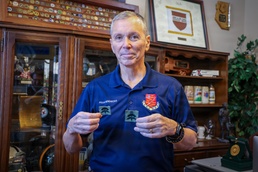
EGLIN AFB, Fla. – The Military Freefall Parachutist Badge represents the elite of Special Operations. It is a skill that allows special operators to stealthily insert themselves into heavily defended areas from high altitude, often undetected. High Altitude-Low Opening (HALO) and High Altitude-High Opening (HAHO) are the types of jumps our military have used for reconnaissance, sabotage and direct action since 1970, when Green Berets with MACV-SOG conducted the first ever combat HALO jump into Laos.
Research on the capability happened shortly after World War II when the U.S. Army saw the success and necessity of Static Line Airborne Operations. The CIA ran experiments during the Korean War with test jumps into the Peninsula. In the 1950s, the Army started formal training with the Army Golden Master Program, testing freefall methods for stealthy insertions behind enemy lines. Despite decades of operational use and proven effectiveness, the military freefall community lacked official recognition until the 1990s.
It was in 1993 when U.S. Air Force Brig. Gen. (Ret.) Fran Hendricks — then a major serving as division chief for military personnel at U.S. Special Operations Command headquarters, MacDill Air Force Base, Florida — received the task directly from Gen. Wayne A. Downing, then SOCOM commander.
Hendricks recalled the moment his supervisor, Army Col. Gary Gresh, relayed the request for an “MFF” badge.
“At the time, I was unfamiliar with the term,” Hendricks said during a recent interview. “When it was explained that it stood for ‘military freefall,’ it introduced me to a capability I had not previously encountered.”
That single conversation launched Hendricks on a mission that would ultimately give the special operations community its long-overdue badge.
With no prior freefall experience or jump wings of his own, Hendricks traveled to Fort Bragg, North Carolina, where the HALO committee was then based. He walked into a room full of seasoned instructors — the legendary “black hats” — as an unqualified Air Force major. The room initially paid him little attention until the committee chair introduced him: “This is Major Hendricks from SOCOM. He’s here to talk to you about designing a badge for freefall.”
Suddenly, everyone had suggestions. Hendricks listened, researched the history and requirements of HALO/HAHO operations, and brought the community’s ideas back to MacDill. He partnered with retired Army Col. James Phillips of the Special Forces Association and Phillips Publications, whose graphic artists turned concepts into designs. They also drew heavily on an earlier 1983 proposal submitted by Sergeant First Class Gregory A. Dailey of 5th Special Forces Group’s ODA 552 — a concept that already captured the essence of what the badge should represent.
The final design features a Fairbairn-Sykes dagger (symbolizing special operations infiltration), superimposed over wings and a modern ram-air parachute. It perfectly captured the unique demands and heritage of military freefall. Gen. Downing reviewed the proposals and gave the green light. The badge was first approved for wear by personnel assigned to U.S. Special Operations Command and its subordinate units on Oct. 1, 1994. Full, unrestricted authorization across the Army followed on July 7, 1997, when Army Chief of Staff Gen. Dennis J. Reimer signed off.
Looking back more than three decades later, Brig. Gen. (Ret.) Hendricks — who never earned the badge himself — said he remains proud of the role he played.
“I was just a small cog in the wheel that helped make the badge possible,” he said. “I have the utmost respect for those who wear it. They’ve gone through something most people will never understand. To me, it’s one of the most elite qualifications in the military.”
Today, the Military Freefall Parachutist Badge stands as official recognition for the quiet professionals who have been inserting undetected from the skies for generations. Thanks to one Air Force major’s unexpected assignment — and the collaboration of the entire freefall community — those operators finally have the distinctive mark of excellence they long deserved.