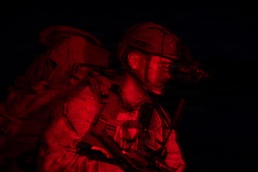
MARINE CORPS BASE CAMP PENDLETON, Calif. – Among the ever-increasing reliance on fast, credible, and consistent information, U.S. Marines with 1st Radio Battalion, I Marine Expeditionary Force (MEF) Information Group, (MIG) and allied participants from the United Kingdom, Canada, and Australia are hosting the Radio Reconnaissance Operators Course (RROC). The course is designed to sharpen existing skills in electronic warfare, signals intelligence, and reconnaissance operations for radio reconnaissance Marines and allied forces Throughout the duration of the RROC, students are expected to participate in classroom instruction detailing radio frequency theory, conduct urban reconnaissance and surveillance operations, maritime targeting, and a long-range insertion to enable joint fires. In addition to U.S. Marines from 1st, 2nd, and 3rd Radio Bn., international participation highlights the importance of multilateral training across the physical and information domains. Not only does the course challenge Marines and their allies to excel in their craft, but it also requires continuous cooperation to further strengthen combined warfighting readiness and interoperability.
I MIG Marines consistently spearhead the use of emergent capabilities throughout I MEF, all while continuously developing the new breed of information warriors. RROC is no exception. RROC is being pushed to new heights this year by extending the course length, adding new equipment and scenarios, and leveraging access to the Twentynine Palms Marine Air-Ground Task Force Training Center, California, to support diverse training objectives. The radio reconnaissance community, led by 1st Radio Bn., shows how lethality blooms when information-related capabilities are combined with combat proficiency.
Gunnery Sergeant Chris Jakeman, the Radio Reconnaissance Platoon, 1st Radio Bn., I MIG, staff noncommissioned officer in charge, describes the impact this training has on Marines and other participating units, stating. “The RROC provides students with experience employing signals intelligence and electronic warfare equipment through five realistic full mission profiles spanning from crisis to conflict, that mimic the conditions of current deployments and future anticipated mission sets. RROC graduates emerge from the course prepared to integrate with units across the MEF and provide signals intelligence and electronic warfare support to the targeting cycle. In a world of rapidly evolving and increasingly complex threats, Radio Reconnaissance Marines remain one step ahead of any potential adversary.”
To fight and win in the emerging information domain, strong allies are paramount. Participation from the United Kingdom, Canada, and Australia in the RROC serves as a testament to how the U.S. and its allies can integrate across all warfighting functions to support a more modern and lethal force.
When asked about the impacts that including foreign allies has on radio reconnaissance training, Gunnery Sgt. Jakeman explained that, “Incorporating foreign allies and partners into the RROC significantly benefits the student population from the three Marine Corps Radio Battalions. It gets them used to working alongside allies and partners, and it allows them to learn from and incorporate the tactics, techniques, and procedures of experienced signals intelligence and electronic warfare operators from partner countries. Radio Battalion Marines greatly profit from our partners’ experience gained from different training, deployments, and the employment of different equipment.”
The execution of this year's RROC shows the dedication of I MIG in supporting and fostering the growth of the Marine Corps' information-related capabilities. Not only is 1st Radio Bn. and I MIG supporting the Marine Corps, but they are supporting all of the participating units and countries and preparing for a future of increased collaboration and strengthened military ties.