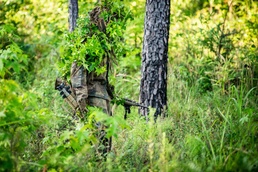
Fort Benning, Ga. – The U.S. Army Sniper Course (USASC) at Fort Benning is working to improve sniper survivability and lethality in large-scale combat operations by evaluating and integrating advanced signature management technology into training.
“What we’ve seen in the last few years in recent conflicts has been a lot of drone activity and having to hide from and defeat thermal and drone systems,” said Staff Sgt. Brett Bollinger, a USASC instructor. “That’s what really drove us to develop these plans because those are the type of assets our near-peer adversaries are going to have in large-scale combat operations.”
Bollinger further explained that boosting sniper effectiveness remains pivotal to military success even as modern warfare has changed traditional battlefield practices.
“Snipers are a critical asset to any commander on the battlefield. If the air is contested, and you can’t fly friendly drone assets, you still must have the ability to insert small, two- to three-man teams to conduct surveillance and then place accurate fire onto the enemy if needed,” Bollinger said. This observation has played out time and again in the Russia-Ukraine War where drones are playing a significant role in battle.
USASC’s new initiative, being done in collaboration with the Small Unmanned Aircraft Systems (sUAS) Master Trainer course and industry partners, seeks to reduce the likelihood of detection across the electromagnetic spectrum, thereby helping Soldiers blend into their backgrounds when viewed by enemy systems and sensors.
According to Bollinger, the course has been testing multispectral thermal-defeating mitigation technologies provided by various companies.
“The materials we’ve been evaluating are full spectrum signature management camouflage systems,” Bollinger said. “We’ve been evaluating products with the objective of defeating thermal sensors, whether it be aerial or ground systems.”
The camouflage systems USASC has been working with look similar to camouflage nets, added Bollinger. They are designed to mask the visibility of a sniper’s movements.
The course gained interest in evaluating advanced signature management technology in early 2025 following an exercise with drones, according to Staff Sgt. Craig Mordaunt, also a USASC instructor.
“We had Soldiers from our sister company come out with drones and that’s when we started conducting tests of how students would react and adjust to air assets flying overhead during practical exercises for our stalk lanes,” Mordaunt said.
USASC has done much of their testing during stalk lanes, which prepare snipers for real-world missions. In these exercises, snipers must use elements of surrounding natural vegetation to further camouflage their ghillie suits and make their way through obstacles to eliminate a target while remaining undetected.
Bollinger said USASC began integrating thermal-defeating systems into stalk lane exercises following a presentation at a Fort Bragg, North Carolina, sniper class last summer from industry partners on their specific spectrum signature management camouflage systems.
“We had a local representative from one of those companies come out a few months ago with camouflage systems for instructors to use and they conducted the stalk lane as if they were the students and they were able to get quite close to the observer’s vehicle while remaining undetected,” Bollinger said.
In January, USASC, along with instructors from the Reconnaissance and Surveillance Leaders Course (RSLC), tested additional signature management products provided by the same company.
“We were able to camouflage a vehicle, set up a static hide site and then observe it with thermal products they brought out to see what such a scene would look like and how effective their technology is,” Bollinger said.
The Sniper Course is still in the early stages of integrating these new products into their training, tactics and plans, and is actively looking at developing and testing them further to keep pace with evolving battlefield technologies.
“For every measure that the world comes up with, there’s a countermeasure to it. And for every countermeasure there’s a way to counter that, so it’s just an ever-evolving circle of defeating new systems,” Mordaunt said. “We’re just trying to increase the survivability of our Soldiers that we send out to the force.”