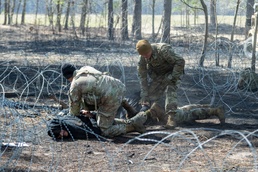
FORT BRAGG, N.C. — At the center of a high-tempo training environment, the detainee collection point became the focal point of operations as soldiers from the 21st Military Police Company (Airborne) and the 525th Military Intelligence Brigade executed a four-day detainee operations exercise in preparation for large-scale combat operations.
Often referred to as the first critical link in the detainee operations process, the detainee collection point (DCP) is where chaos meets control. It is the initial site where personnel are received, searched, documented and prepared for further processing — all under conditions designed to replicate the stress and uncertainty soldiers may encounter in combat.
“This training exercise allows us to work alongside our military intelligence partners to create a more cohesive team during operations,” said Sgt. Julian Valenzuela-Cobian, military police, 21st Military Police Company (Airborne). “There have been times we have shown up to an exercise assuming military intelligence will handle a certain aspect of the DCP and vice versa. This often causes confusion in responsibilities leading to negative outcomes.”
Valenzuela-Cobian stated the units also utilized this exercise to establish a standard operating procedure to clear up lines of communication between the formation.
Throughout the exercise, squads established a fully functional DCP in an austere field environment. Concertina wire, temporary barriers and entry control points defined the perimeter, while soldiers moved with urgency to receive incoming detainees from notional forward units. Each arrival triggered a coordinated response — security teams maintained overwatch while search teams immediately began systematic procedures.
Detainees were searched for weapons and contraband, silenced to prevent communication, segregated based on status and intelligence value, safeguarded to ensure humane treatment, and moved quickly through the process to prevent bottlenecks.
Accountability remained the top priority. Every detainee was tagged, logged and tracked from the moment they entered the DCP. Soldiers maintained detailed records, ensuring a clear chain of custody as individuals moved to holding areas or were flagged for intelligence screening.
Simultaneously, HUMINT collectors from the 525th Military Intelligence Brigade operated in close proximity, observing and conducting initial screenings at the collection point. Their presence allowed for the rapid identification of detainees who may possess valuable information, accelerating the intelligence cycle from the earliest stage.
The pace was relentless. Waves of detainees arrived with little warning, forcing soldiers to adapt and expand operations in real time. Role players portraying enemy combatants introduced friction — some were compliant, others resistant or intentionally disruptive — testing the discipline and professionalism of the soldiers at every turn.
Despite these challenges, noncommissioned officers enforced standards at every level. They moved through the formation, correcting deficiencies, reinforcing proper search techniques and ensuring soldiers understood the importance of the training.
“I want our junior soldiers to understand the importance of every role within the detainee collection point,” said Sgt. Tattum Truex, military police, 21st Military Police Company (Airborne). “Also, gaining a better understanding of how to effectively work alongside adjacent units who provide a different mission set in combat.”
The exercise underscored the critical role of the detainee collection point in large-scale combat operations. As the first echelon of control, the DCP sets the conditions for everything that follows — from long-term detention to intelligence exploitation.
“As the Army moves forward, we are transitioning into a period where detainee collection points will become a primary mission set for military police,” Truex said. “It is a key element for us to focus on and become more proficient in order to help units downrange.”