ROCK ISLAND ARSENAL, Ill. – On Feb. 22 a blizzard swept across Aberdeen Proving Ground, Maryland, burying the Army installation in nearly two feet of snow.
In surrounding communities, life grinded to a halt. Schools closed, stores closed, and people stayed indoors. But APG, home to emergency services, critical military research, weapons testing and thousands of people supporting Army readiness, could not simply shut down and wait out the storm.
Fortunately, the Logistic Readiness Center APG was ready.
“The mission of the LRC is to guarantee the operational readiness, safety and longevity of the garrison’s entire fleet of vehicles and equipment,” said Moses Golden, LRC APG director. “As the entity responsible for all rolling stock, the LRC provides the foundational support that every garrison directorate depends on to perform its duties.” In Army logistics rolling stock refers to vehicles, primarily railcars such as boxcars and flatcars, used to move equipment, supplies and personnel into theater.
LRC APG – a subordinate unit of the 404th Army Field Support Brigade under the U.S. Army Sustainment Command – provides the installation-level logistics that keep Soldiers and units supplied, maintained, transported and ready. As part of ASC’s network of brigades, battalions, and more then 80 LRCs, the team contributes to the command’s broader mission to deliver installation logistics, manage Army Prepositioned Stocks, and integrate enterprise sustainment functions. That foundation enabled LRC APG to keep vehicles running and operations moving despite the blizzard.
Golden said snow-removal operations are a prime example of that mission. Long before winter weather arrives the Maintenance division conducts pre-season inspections and services the entire snow removal fleet, including plows, spreaders, and heavy equipment, to ensure everything is prepared when a storm hits.
While the APG Garrison Directorate of Public Works operates the equipment, the LRC’s maintenance is the critical enabler. DPW keeps the base running by taking care of the buildings, roads, utilities, housing, and the environment. They rely on a wide range of vehicles to do that work, and when those vehicles break down, operations stall. The LRC provides the maintenance that keeps DPW’s vehicles working, along with transportation, supply, and equipment tracking. During severe weather emergencies, this support becomes essential - DPW can’t respond quickly unless the LRC keeps their vehicles ready to roll.
In the event of a mission stoppage driven by severe winter weather, APG must halt all outdoor testing because test areas can’t be used safely. Indoor research also slows or pauses because most scientists and engineers are instructed to stay home. The focus shifts from testing and innovation to protecting people, equipment, and ongoing critical experiments until the installation reopens. These delays can ripple through development and fielding timelines and increase costs as postponed tests must be rescheduled and equipment re-secured.
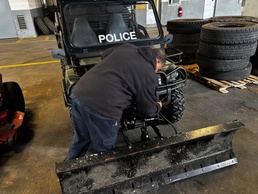
When the blizzard struck, Col. Troy Johnson, APG garrison commander, ordered all snow-removal vehicles to run around the clock to keep the installation open. To keep those plows, salt spreaders and support vehicles operational, the men and women of LRC APG provided continuous emergency maintenance throughout the storm. A mobile maintenance team was dispatched directly to the vehicle’s location for on-site repairs, allowing equipment to return to work as quickly as possible with minimal disruption. If an issue was too complex for field repair, the vehicle was towed to the maintenance shops for more extensive work.
As the blizzard intensified, so did the risks.
“The inability to clear roads directly impacts the installation’s ability to maintain its mission‑readiness, impedes emergency services, restricts troop and equipment movement, supply chain disruption and infrastructure damage,” said Emily Myers, garrison public affairs officer, APG. Heavy snow, harsh winds and a demanding operational tempo increased the likelihood of snowplow breakdowns. Every delay risked shutting down the Army’s premier research and testing installation.
For LRC APG, the storm became a test of coordinating snow‑removal operations across APG North and South. Golden noted that the challenge was not only the weather itself, but ensuring the response remained unified rather than splitting into separate efforts.
APG’s two main areas - APG North and APG South - are geographically separated by 15 miles and were originally distinct installations (APG and Edgewood Arsenal) before merging in 1971.
“The LRC’s work ensures that APG is treated as one installation, with resources directed to where they are most needed, regardless of the location,” said Golden.
The concern going into the storm was that without LRC oversight, APG North and South would have split into competing operations. To prevent this, clear lines of communication were established that allowed DPW to directly call the maintenance shops at each site to request service.
To maintain unified oversight, the LRC’s contracting officer’s representatives were activated to provide continuous coverage. CORs prioritized service based on mission need. A COR is a government employee, (Civilian or Soldier) who ensures the contractor is doing the work the Army is paying for.
When high-priority work was required on both installations simultaneously, CORs deconflicted priorities to ensure contract teams focused on the most critical assets across the entire installation, not just one area. Without that oversight, contracting teams would have defaulted to a “first in, first out” approach. This approach could have left a critical snowplow at APG South idle while a less essential vehicle was repaired at APG North.
Even before the first snowflake fell, the contractors working for the LRC performed scheduled maintenance and established dedicated parts (hydraulic hoses, belts, batteries and common electrical components) caches at both APG North and South.
During the storm, the maintenance bays never went dark. Contractors worked through the night repairing snapped hydraulic lines, burned-out spreader motors and transmissions pushed to their limits. Golden said what impressed him most was the unity of effort. “The ability to respond immediately to DPW’s needs, without delay and regardless of location, was exceptional. It highlighted a unified sense of mission that transcended geography.”
In a storm defined by isolation and whiteout, the LRC delivered something rare: unity. Their around‑the‑clock emergency maintenance didn’t just keep vehicles running, it kept APG mission‑ready when it mattered most.