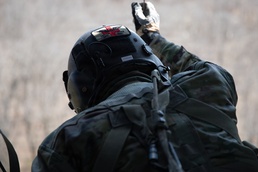
NEW PROSPECT, Wis. --- Soldiers from the Wisconsin Army National Guard’s 1st Battalion, 147th Aviation Regiment conducted a search and rescue training exercise at Kettle Moraine State Forest near New Prospect, Wis., March 27. The crew executed three variations of hoist extractions in a heavily wooded area to simulate realistic scenarios.
The aviation crew consisted of two pilots, two crew chiefs, and two flight medics during the exercise. Crews are rarely the same in the aviation community due to the high-octane pace they train for.
“When we deploy, we tend to just kind of pull from all different [aviation] units and go,” said Sgt. 1st Class Michael Furbee, a flight medic with Detachment 2, Company G, 2nd Battalion, 104th Aviation Regiment.
The first hoisting method the crew used was a rescue seat where the flight medic and patient strap onto an upside down T-shaped seat, sit down, and then get hoisted up into the UH-60L Black Hawk. The rescue seat is generally used to provide rapid transport to injured or incapacitated people over short distances.
The second hoisting method was an air rescue vest that the unit recently started incorporating into their search and rescue exercises. The vest is applied to the patient by sticking both arms through a hole and bringing the bottom part of the vest through the legs, securing the individual in a cradled position. Then the flight medic attaches the patient and themselves to the hoist and are lifted back up to the Black Hawk. The air rescue vest was created for a safe, comfortable, and secure full-body rescue device used for short transport.
The third hoisting method used was a rescue litter where the patient is placed onto the litter and firmly secured. The flight medic then secures the litter and themselves to the hoist to be lifted out of the area back into the Black Hawk. The rescue litter is used to provide structural protection, stabilization, and secure immobilization for patients during complex aerial extractions.
Search and rescue training exercises are pivotal in ensuring air crews are ready to support first responders. In 2019, the unit responded to a call to support the Baraboo Fire Department to rescue a hiker who had been pinned by a large rock at Devils Lake State Park.
“I try to be your best day on your worst day,” said Spc. Taylor Jordan, a crew chief operator from Company C, 1st Battalion, 168th Aviation, regarding his view on serving the community.