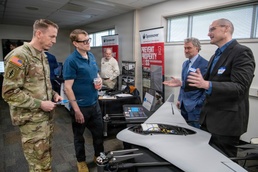
Success in The Profession of Arms calls for more than elite troops and cutting-edge equipment. It demands effective management of evolving needs and making informed program decisions to turn ideas into tangible results. At the Oregon Military Department 2026 Innovation Summit, military leaders, partner agencies, academic instructors, and industry experts came together to explore new ways to advance technology for U.S. warfighters in the Pacific Northwest, sharing practical insights to guide future efforts and avoid unnecessary detours and costly setbacks.
The Oregon Military Department Innovation Summit (OMDIS) hosted a two-day event at Camp Rilea Armed Forces Training Center near Warrenton, Oregon, on March 23 and 24, 2026. Rally Point Ventures, the organizer, focuses on helping startups that create products for both military and commercial use. They connect these startups with Department of War and Department of Defense buyers, and help them find non-dilutive funding and opportunities to pilot/field-test their products. Rally Point Ventures has helped originators turn real-world needs into practical steps and has supported military partners in finding and developing new technology.
“There’s a phrase that exists in the United States military that concerns and worries me: ‘Late to need.’ We’re constantly behind when it comes to meeting our needs,” said Oregon Air National Guard Col. Adam Gaudinski, commander of the 173rd Fighter Wing, as he opened the event, touching on the increasing pace of adapting new technology. “So now where are we? Where is AI? What is it going to do for us?”
"Late to need" is a term commonly used in military and defense acquisition to describe situations in which critical capabilities, equipment, or forces are not delivered in time to support operational requirements. On April 30, 2025, Secretary of Defense [War] Pete Hegseth issued a memorandum titled "Army Transformation and Acquisition Reform," which outlined the Army Transformation Initiative to Congress and underscored the necessity to “cancel programs that deliver what is described as dated, late-to-need, overpriced, or difficult-to-maintain capabilities.”
“We build constellations, satellites, and GPS capabilities that are, once again, revolutionary,” Gaudinski said, emphasizing the spirit of ingenuity and entrepreneurship. “With government support to manage the risk, the private sector has the space to step in and create these innovative and exciting things… that start with an idea in your garage. That’s Americanism.”
Gaudinski summarized his opening by posing several questions for the group to reflect on during the summit: “How do we build faster? How do we cut through the bureaucratic red tape? How do we bring this to the warfighter, to society, and protect future generations?”
This didn’t take long, as nearly 120 participants took the first of many coordinated breaks to start those conversations. The interaction among vendors, participants, and scheduled speakers around Warrior Hall was noticeably lively and energetic.
Taking this enthusiasm from the break, Chris Pavel, Founder and CEO of Rally Point Ventures, described how he saw a need for this type of product innovation management organization, which he started after retiring from the Washington Air National Guard.
“Everyone on our team has worn the uniform and brings both expertise and a problem-solving approach to this work,” he said, while showing the early framework with several slides. “What we found is that starting with the end in mind, and focusing on ‘starting with the why’ is important to achieve operational success, to find and fill in the capability gap.”
Founded in 2025, the team possesses more than 160 years of collective defense experience. The summit leverages this proven track record and offers military and industry professionals actionable guidance to help them make decisions more efficiently and effectively.
"Many of you know about the 'frozen middle,'" Pavel said, noting that project approvals often stall for various reasons. "By addressing barriers such as funding gaps, investment shortfalls, and by clarifying needs and DoW requirements, we can improve our success in these cross-sector relationships."
With that, a series of scheduled professionals presented their areas of expertise over the rest of the summit, with working group lunches and interactive breaks.
In describing both the speed of innovation and cutting-edge tools, Marguex Gala, with Augmented AI, led a discussion on how organizations can make better decisions faster and with greater clarity using AI technology during her presentation.
“Our philosophy is that human endeavors come first, especially in a military context; you are not going to solely make a decision based on what is the most optimal, or what is the most efficient, and what is the path of least resistance,” she said, recognizing the need to weigh the desired risk in life and death decision-making. “So AI is not responsible in vital risk situations. Human judgment needs to come first and should be part of the strategic process.”
Using current statistical data, accounting for costs, and considering other factors that affect project timelines, artificial intelligence is among the most innovative tools of recent years. The overall, long-term goal for AI might be to have a basic tool that one can ‘plug and play’ with, but keeping accurate, up-to-date data, using prior cost analyses, and asking the right kinds of outcome questions are critical for the cost-benefit analysis.
“We want to move fast. We want to make things more efficient, but we are also talking about leveraging real intelligence, real human experience - our instinct. There is so much value there,” Gala said, looking at all of the factors for success and the full array of AI applications. “The funny thing about my team is we’re vertical agnostic and tech agnostic. We use every AI tool available to help you (end user) accelerate and achieve your goals.”
Using this innovative approach and focusing on human responses and performance, three representatives from the Air Force Research Laboratory, 711th Human Performance Wing at Wright-Patterson AFB in Dayton, Ohio, presented several ongoing Health and Wellness Initiatives projects at the OMDIS. Building on AFRL's mission to “discover, develop and deliver integrative human performance knowledge, technology and solutions,” the presentation focused on human performance obstacles and practical solutions.
“So let’s talk about this link between AFRL and the Air Force's priorities, as well as the medical side funding that allows us to use really creative collaborative things that bridge the gap between performance and medical,” explained Dr. Nicole Ray, Director of the STRONG Lab at AFRL, referring to ongoing physiology programs her team has been working on. “Right down the hall from us (at Wright-Patterson) is USAFSAM, the School of Aerospace Medicine, so we have all of this expertise in the same building.”
Through collaboration with the Air Force and Navy Research Laboratories, USAFSAM maximizes the application of aeromedical science and technology to enhance the performance, health, and survival of individuals in abnormal or extreme environments, such as combat, air, space, and cyberspace. Dr. Ray described a study conducted in extreme cold-weather environments.
“So rather than having a bunch of little one-off projects, we have a more unified focus, and we can achieve things on a larger scale,” she said. “Looking at FROST Advisor, which is a custom GPT to generate responses related to cold weather environments. The user can detail a question and get recommendations for active mission sets.”
The sample question for FROST was, “I have a mission for 5 days in -50 degrees, what should I wear?” Within seconds, FROST generates recommendations for base-layer clothing, insulation layers, outer layers, and hand, head, and foot protection. Now the service member can pack all the critical gear and review guidance based on the latest research and field data that FROST can calculate.
Technology and real-time data collection are also important for AFRL human performance research when used with wearable devices. Tracking body temperature, heart rate, oxygen use, and hydration in real time provides some of the best holistic indicators for long-term performance.
“In our lab, our mission is to facilitate high fitness levels. So when we design these studies, our hypotheses, our research, or design and our analysis – we do this with the intent to improve fitness,” said Maegan O’Conner, a Human Performance Researcher with AFRL, yet also described some of the challenges with wearable devices. “We have found that for some, it’s a culture change where users aren’t comfortable with the personal data collection, even though we don’t put a name to the data. For others, it is a nuisance, and in some cases, there are security issues with GPS tracking a service member’s location.”
Collecting physical data and vital signs is not new in the U.S. military. In his 2011 book “WAR,” author Sebastian Junger wrote about decades of human performance studies in combat, which he found still applied to the soldiers he reported alongside in Afghanistan. He described how, in 1966, Army researchers took daily blood and urine samples from soldiers camped deep in enemy territory along the Cambodian border in South Vietnam to monitor their stress levels.
The study showed that two officers in the unit saw cortisol levels climb until the day of an expected attack, and drop when it failed to materialize, Junger wrote, citing the study The Psychology and Physiology of Stress with References to Special studies of the Vietnam War, by Peter G. Bourne. “Among the enlisted men, the stress levels were exactly the opposite: their cortisol levels dropped as the attack drew near. The only explanation the researchers could come up with was that the soldiers had such a strong physiological defense that the attack created a sense of ‘euphoric expectancy’ among them.”
Before the Innovation Summit, Ray, O’Conner, and AFRL associate Kristyn Barrett experienced this sense of 'expectancy' by joining the Oregon Best Warrior Competition at Camp Rilea. They saw firsthand the tough psychological and physical challenges service members faced during three days of intense endurance events under the nonstop competition agenda.
O’Conner stated, “This was a valuable precursor to the summit. It allowed us to be out there and observe participants in changing weather conditions and various situations. It’s a great reminder, too, of why this research is so important.”
Whether it comes from observations, wearable devices, controlled experiments, or published studies, each provides data that helps advance artificial intelligence, enabling it to make inferences and offer up-to-date recommendations.
As the nature of warfare continues to change in real-world situations, Oregon Army National Guard Lt. Col. Mark Timmons, commander of the 249th Regional Training Institute at the Rees Training Center in Hermiston, Oregon, began his presentation by asking for feedback and suggestions on the cost of building, testing, and developing custom-built aircraft to supplement some of the specialized commercial systems.
“Can somebody tell me what air superiority looks like when we have to take on a thousand drones? Right now, nobody knows the answer to that question,” Timmons said, pointing out the rapid reconfiguration of the modern battlefield. “We now have the chance to design and build our own aircraft using 3D printing. By working with a company that specializes in both technology and compliance, we can combine our efforts to create a system made in Oregon and, more broadly, in areas around the world.”
Simmons described how he has used ‘Sparkle Ball’ to drop from drones on soldiers in the field training to simulate battlefield ‘kills,” which he bought commercially. He also wants them to learn innovation, but a variety of limited-cost options sidelines them.
“I want them to take your ingenuity – you know the parts, you know the integration, you know the coding,” he said, addressing the summit audience. “I then want to take your ingenuity and put it in a system that I can build, print, and adapt 3-D drones to shape our training missions.”
The biggest concern is the product's quality vs. the price per unit, as it’s difficult to train without an affordable platform, Timmons noted. “I don’t have the budget to buy 20 drones at $40,000, but if we can get a usable product at around $2,000 per unit, then we can fly, fix, and adapt to that technology.”
One key benefit of the innovation summit is that it helps solve urgent problems quickly, without relying on the slower traditional contract bidding process.
“Innovation is like resiliency. It can be an overused term; it's not the idea but more about getting things done at the lowest level,” said Oregon Air National Guard Capt. Jarod Boyer, who has orchestrated these last two years of the OMDIS. “On a scaled-down version, Air Force squadrons have similarly managed their resources.”
Boyer brings both his technical skills and budgetary knowledge to this process, having worked for several years in the Avionic back shop repairing aircraft system components before obtaining his commission, and now is the Budget officer for the F-35 Lightning IIconversion at the 173rd Fighter Wing at Kingsley Field in Klamath Falls, Oregon.
“So I do think of ways to build teams up, that correctly solve problems, to flesh out the details, where solutions can be solved at the lowest level, and have an added cost saving to the resolution,” he said, describing how he wants to “get everyone at the table to talk to each other.”
While looking for ‘crossover effects,’ Boyer said, observing that if the “Oregon National Guard already has a drone training program and the ranges to operate them, there shouldn’t be a problem obtaining additional manufacturing equipment and printers for the Army by sharing resources.”
“At some point, the Air side will need that technology too. Why aren’t we working with the Army on more issues? Both services have some of the best training ranges because our state isn’t very crowded,” Boyer said, reflecting on long-term ‘win-win’ outcomes. “If we use our strengths, I think we’ll keep hitting home runs and succeeding.”
The second- and third-order effects of this innovation crossover include increased recruiting numbers and students at the high school and college levels seeking these technology-driven careers, both in civilian jobs and in the National Guard.
“My biggest goal is to build something that lasts beyond my own career. By working with universities and community colleges, we can close the technology gap and bring in the people we need,” Boyer said.
The summit concluded by answering many of the questions posed by Col. Gaudinski in his opening remarks and underscoring that innovation is not a static proposition or theoretical concept in the profession of arms.
“Innovation does not lead to leadership; innovation does not lead to success. Our ability to operationalize that scale is what accomplishes successful leadership,” Guadinski said. “So, whether we talk about our state or region or go national, who else is better to lead than us? How about you? How about me? I can’t wait!”