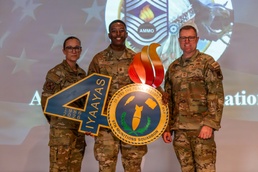
BEALE AIR FORCE BASE, Calif. – After a grueling three weeks, Air Force Combat Ammunition Center (AFCOMAC) class of 2026-004 delivered their signature booming ammo chant marking the finale of a dual celebration; their graduation and AFCOMAC’s 40th Anniversary. Throughout the course, under intense Northern California heat, these students were able to develop and implement their Munitions Employment Plan which details how they’ll maintain, build and transport hundreds of munitions. All these abilities are honed in preparation to integrate their newly acquired skills throughout their career in the U.S. Air Force.
After a perceived degradation in the Air Force’s ability to rapidly produce ammunition for air combat operations during the Vietnam War, a specialized “Tiger Team” was developed to solve this problem. The solution was AFCOMAC. It was established in 1985 at the Sierra Army Depot, California and the first class was held in 1986.
The Gulf War of 1991 was a defining moment for air power, demonstrating for the first time how modern conflict would be dominated by aerial forces. As a result of AFCOMAC’s intensive training, Air Force munitions personnel supported the wide-scale use of precision-guided munitions that achieved rapid air superiority and the destruction of key infrastructure, communication systems and command and control capabilities that paralyzed the Iraqi force’s ability to operate prior to the ground war. With their significant contributions, AFCOMAC cemented its position as an integral component in this new age of warfare.
AFCOMAC was later moved to Beale AFB in 1991 with its first class held there in 1992.
“Aside from monetary and funding reasons, AFCOMAC moved to Beale AFB based off the capabilities that Beale brought,” said Master Sgt. Adam Pawlak, 9th Munitions Squadron (9th MUNS) AFCOMAC instructor. “It’s a big open base and if you’re executing the largest explosive operation in the entire joint force, in fact the largest in the entire world, Beale does a good job at mimicking a deployed environment.”
Since its inception, AFCOMAC has delivered on its mission to provide advanced training in mass combat ammunition planning and production, preparing personnel to establish bomb dumps and build thousands of live munitions in realistic, bare-base scenarios. Trained by instructors at the 9th MUNS, the students learn to set up operations under the conditions of a simulated forward deployment.
AFCOMAC provides two courses to further enhance their students’ technical and war-fighting capabilities. The Combat Ammunition and Production (CAPP) course can have 70 to 80 people in grades ranging from E-4 to 0-3. The course is required for those looking to complete their upgrade training to receive their 7- and 9- skill levels and is comprised of two weeks of academics followed by a weeklong exercise, Iron Flag. The other course offered is the Senior Leader Aerial Munitions Course (SLAM-C), a companion class to CAPP conducted alongside Exercise Iron Flag to provide hands-on training and seminar sessions for senior logistics and operations officers.
“Over the last 40 years our mission at AFCOMAC has remained the same: to train, develop and empower warfighters and advanced munitions planning and production to fuel combat capability across the globe,” said U.S. Air Force Maj. Christopher Parmer, 9th MUNS commander. “The impact of AFCOMAC delivers the Department of War’s ability to operate on a global scale, ensuring that every bomb built, every missile loaded and every ammo troop trained meets a standard that enables combat air power on demand, anytime and anywhere in the world.”
The CAPP course’s academics include classwork and bomb build plans, with studying and planning often carrying over into the weekends. Exercise Iron Flag challenges students to utilize munitions assembly conveyers that introduce assembly line concepts to munitions building. They build hundreds of differing types of ordnance used by varying airframes and palletize the munitions before loading them up on trucks for simulated transport.
AFCOMAC has held over 298 classes with more than 21,000 graduates who together have built more than 327,658 bombs.
“When a combatant commander requires precise, overwhelming effects, it starts with the Airmen trained here,” said U.S. Air Force Brig. Gen. Jon A. Eberlan, director of Logistics, Engineering and Force Protection, Headquarters Air Combat Command. “Ensuring the right munitions are built in the right quantity, configured properly and delivered with lethal precision, there is no room for error.”
In 2024, the CAPP and SLAM-C courses included students from the Air Force weapons loader career field as well as U.S. Navy and U.S. Marine Corps aviation ordnance officers. In the same year, student participation also expanded to the United Kingdom’s Royal Air Force and the Canadian Air Force. Since then, members of the U.S. Marine Corps munitions career field have been regular students in the CAPP course.
“Integrating joint service training is essential to work as a cohesive team during real world missions,” said U.S. Navy Chief Petty Officer Plaza, aviation ordnance supervisor and AFCOMAC class of 24-005. “By the end of the course, producing munitions felt like second nature to how I would operate with aviation ordnance Sailors.”
In 2025, representatives of the Japanese Air Self-Defense Force visited Beale AFB to observe the SLAM-C course, and there are plans to incorporate more allied partners in AFCOMAC. Such integration enables a unified approach that enhances the readiness, effectiveness and lethality of both the Air Force and allied partners.
“As we celebrate this milestone of 40 years, we will continue to expand as we include joint and allied partners into our curriculum as the Department of War’s premier institution for warfighter readiness and combat capability,” Parmer said.
With the integration of the latest technology, munitions and logistics techniques with real-world training applications, AFCOMAC has enabled the munitions and weapons loading career fields of the U.S. military to be unmatched. Their ability to rapidly replenish aircraft while incorporating Agile Combat Employment principles to bolster mass combat ammunition planning and production enhance lethality and supports air superiority when our nation demands it.
“As threats evolve, the responsibility remains clear,” Eberlan said. “To deliver combat power with precision and this school continues to produce the professionals who make it happen.”