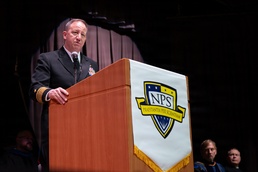
MONTEREY, Calif. — The Naval Postgraduate School celebrated its 2026 Winter Quarter graduates during a commencement ceremony March 27 in King Hall Auditorium, awarding 183 advanced degrees in defense-focused disciplines to 181 graduates, including 34 international military officers representing 22 countries.
The graduating class includes 72 U.S. Navy, 26 U.S. Marine Corps, 17 U.S. Army, six U.S. Air Force, one U.S. Space Force and 25 civilian students. Four earned doctoral degrees, 136 earned master's degrees, 59 are distance learning students, and 60 have completed Joint Professional Military Education.
NPS president retired U.S. Navy Vice Adm. Ann E. Rondeau opened the ceremony by welcoming graduates, families and distinguished guests, and emphasizing the school’s role in preparing warfighters to address real-world operational challenges. She noted that the graduates’ efforts in education and research were already contributing to the fleet and broader joint force, and encouraged them to carry forward the professional networks and mindset of continuous learning they developed at NPS.
"While the Winter Quarter class size is typically the smallest each year, you are no less important," said Rondeau, emphasizing the role of international students in strengthening global partnerships. "Your work, and everything we do here at NPS, is applied. In many cases, your efforts are already making a difference."
Rondeau stressed that work conducted at NPS is applied, not theoretical, and directly tied to operational challenges across the fleet. She then introduced commencement speaker U.S. Navy Vice Adm. Jeffrey Czerewko, the Navy’s 61st Chief of Naval Personnel.
In his remarks, Czerewko underscored the role NPS graduates play in delivering warfighting advantage through intellectual development and innovation, and positioned the graduates’ achievements within the Navy’s broader need for adaptable, intellectually prepared leaders.
“The most critical component of a more capable and more lethal Navy is not in steel and fuel, but in intellect,” Czerewko stated. “This is where we forge our intellectual advantage.”
He emphasized the connection between academic rigor and operational effectiveness, describing NPS graduates as uniquely positioned to translate knowledge into action.
“You are not just graduates, you are warrior-scholars, prepared to bridge the gap between emerging technology and operational employment. You are where science meets the art of warfare,” he remarked.
As he closed his address to the graduating class, Czerewko challenged graduates to question assumptions, think critically and pursue the root causes of complex problems rather than surface-level fixes. He urged them to carry that mindset forward as leaders responsible for strengthening the readiness and effectiveness of the force.
“You have been trained to see the problem differently. Be humble, be approachable, but be unreasonable in your pursuit of excellence. Your responsibility is to leave our Navy stronger, more ready, and more lethal than you found it,” he said. “The challenges ahead are immense, but my confidence in our future is absolute because of you.”
That call to rethink how the force operates was reflected in the work of U.S. Navy Lt. Cmdr. Richard Andrews, a graduate in the manpower systems analysis program and recipient of the Chief of Naval Personnel Award for Academic Excellence in Manpower Systems Analysis.
Andrews examined how unconventional thinkers, often described as "mavericks", perform within the force.
"My thesis asks whether we have people who think differently within the force, and if we do, how they actually fare throughout their careers," Andrews stated. By quantifying personality traits and tracking career outcomes, his research found that such individuals are "conditional assets" who can deliver exceptional results when placed in the right roles and environments.
"We need to learn to identify unconventional thinkers, manage them deliberately, and ensure that we're able to leverage them fully," Andrews said.
He credited NPS with providing both the analytical tools and academic support needed to explore complex personnel challenges.
"The potential is that we come up with something that improves everything around us," he said.
U.S. Navy Lt. Roberto A. Pacheco took a different approach, focusing on the technical challenges that underpin operational resilience. Graduating from the electrical engineering program, Pacheco developed and tested energy management algorithms for networked microgrids designed to maintain continuity of power in degraded or contested environments.
"My thesis focuses on creating a networked microgrid infrastructure which allows us to provide continuity of power, even in instances in which we're operating in degraded environments," he said.
Pacheco also completed Joint Professional Military Education through the U.S. Naval War College Monterey program
"The biggest takeaway for me from NPS is being able to view technical problems through an operational lens," he said. "I would like to bring to the fleet my engineering expertise to solve these in-the-weeds issues, such that we're able to maintain operational resilience and reach our mission objectives."
NPS Winter Quarter Graduation ceremony reflected both personal achievement and professional readiness, underscoring the school’s role as an institution where education fuels innovation, strengthens leadership and provides the intellectual foundation for warfighting advantage across the United States and its allies and partners.
Visit the2026 Winter Quarter class websiteto learn more about the graduating class and watch the full ceremony.