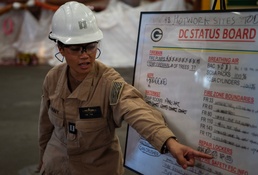
CORONADO, Calif. (March 19, 2026) – The setting was a warm, sunny day in September 2025. Lt. Sydney Tse, from Bayonne, New Jersey, sat in the audience at the Junior Officer Training Symposium (JOTS) hosted by Vice Adm. Brendan McLane, commander, Naval Surface Force, U.S. Pacific Fleet (CNSP). As the auxiliaries officer assigned to the San Antonio-class amphibious transport dock ship USS Green Bay (LPD 20), Tse was working on coordinating between her ship’s wardroom and the wardroom of the San Antonio-class amphibious transport dock ship USS Somerset (LPD 25) to provide maintenance availability training to their junior officers. Somerset would be joining Green Bay in the yard soon, and Tse’s wardroom wanted to set up for success dealing with the transition and challenges of the maintenance phase of a ship’s life cycle. Tse’s interest was piqued. Maybe this is something that junior officers want on a larger scale than just Green Bay and Somerset. During JOTS Tse found herself pitching the idea of a Junior Officer Maintenance Availability Training (JOMAT) course to McLane. Two months and a whirlwind of moving pieces later, Tse was leading the charge on the first iteration of JOMAT. With the course open on a voluntary basis to all waterfront officers, she found the attendance with each day of the three-day course increasing, with a total show-out of 90 people. And the rest, to Tse, was history. “It was November 2025 when we had the first convening, which definitely would not have been possible without the help of [Commander, Naval Surface Group (CNSG)] Lt. Sur,” said Tse. Lt. Dane Q. Sur, from Los Angeles, is a recent graduate of the Advanced Engineering Instructor (AEI) course at Naval Education and Training Security Assistance Field Activity in Pensacola, Florida. He explained that CNSP and the AEI program share a top priority of getting Navy ships out of maintenance availabilities on time, and support for that goal helped bring the JOMAT course to life so quickly. “Planning the convenings and structuring the events took a lot of coordination with different stakeholders of varying levels, from type command entities to junior officers on their first tours, and it was impressive to see the wealth of knowledge we were able to pull from and then share with peers,” said Sur. From the convening of the first course, Tse could tell it was going to make a difference. She and Sur worked with CNSG to coordinate guest speakers from all platforms to talk about their knowledge and experience in maintenance availabilities. They watched as, even after the training was over, junior officers stuck around to ask further questions and soak up information. “JOMAT is unique because it’s the first dedicated effort to train up junior officers on ships entering maintenance availabilities after they’ve arrived and had the chance to learn the context of their jobs,” said Sur. “It’s been an awesome opportunity to work on this and I am looking forward to helping implement it at the other CNSGs as we grow it here at CNSG Southwest.” Tse’s goal is to give junior officers resources and experiences that familiarize them with maintenance availabilities, common hurdles, and terminology so when they are headed into the yards, it is something they can be excited about. “A big goal of mine is actually having discussion, we're not always reading off the slides, we're having conversation, because that's what people remember the most,” said Tse. Even with such a great first convening, Tse made sure the second course was going to be even better. She ended each day by asking junior officers what they would like to learn more about, and if a guest speaker had limited time and they had further questions, Tse and Sur made sure to follow up and provide that information to the junior officers. With such a passion for maintenance availability, a phase most Sailors tend to dread, Tse is flipping the script on what maintenance is all about. “This is something I'm passionate about, because this is where you really get to be hands-on with a lot of your equipment,” said Tse. “This is where you could also make huge differences, because a lot of things are at your purview.” While she admitted that getting to her own level of knowledge was not easy, a large part of her passion for the course is making sure other junior officers have a better experience than she did. She added that the knowledge she has accumulated came from taking the time to sit with the technical experts on board – chiefs, limited duty officers, and the like – and picking their minds until she understood things. “In the yards, it's a lot more free and there's a lot more human interaction that goes on,” she explained. “I'm a lot better leader because I've gone through this whole maintenance phase.” Tse’s passion for maintenance and for the course have not fallen flat. Her relief as auxiliaries officer for Green Bay, Lt. j.g. Jenna Appleton, from Seattle, attended the first convening and found it empowering even as a second tour division officer. “I'm literally using the little booklet she handed out at training,” she said, describing a reference sheet full of terminology and quick explanations of common maintenance events. “Now I have contacts. They gave out a point of contact sheet at that training, too.” Appleton explained that a brand-new Navy ensign still has a role in helping track maintenance and get the ship ready for its operational phase, and she’s glad to see that they have an avenue to get more training in this area. “It’s cathartic, in some ways, having all the junior officers there,” said Appleton. “No one was alone in their struggle.” Appleton isn’t the only junior officer who appreciated JOMAT. Ens. Grace Beane, from Murfreesboro, Tennessee, had nothing but good things to say about her experience there. Having arrived at Green Bay just three-weeks before the second convening of JOMAT, she was new to everything. “Having the experience early on was beneficial,” said Beane. “It was really helpful that both of the main instructors were second tours, and they had experience on different platforms and different ships, so they could talk about what was important on both.” Beane also said that she understands what is happening around her so much better after attending JOMAT. “It makes my job easier because I actually understand what’s going on, and it helps me to learn moving forward,” said Beane. “Extreme ownership,” Tse said. “This is how you can do it . . . It’s not about just doing your job but having pride in doing your job.” The embodiment of “Get Real, Get Better,” Tse believes the future of JOMAT is bright. With dreams of a roadshow-style offering of the training, she is looking for another passionate junior officer to take up the torch as she prepares to transfer to her next assignment. “I can’t help but have impostor syndrome because I’m teaching my peers, but at the same time, it felt really comfortable because I was a peer,” she said. “We were able to ask a lot of things, and I was able to just be real with them.” “Our training pipelines do an excellent job of training us to stand the watch and sail into harm’s way,” said Sur. “But we get minimal training on how to be effective in our roles as division officers when it comes to managing maintenance and ensuring our ships can maintain lethality through the entirety of their lifecycles. Lt. Tse’s initiative was the catalyst for this issue really coming to light, and working with her to fix the problem at the junior officer level has been incredibly rewarding.” Beane said she thinks everyone can benefit from JOMAT and anyone should go to it, explaining that the earlier you learn, the more opportunity you have to grow. To other junior officers, Appleton had one message: “It will empower you. Go.”