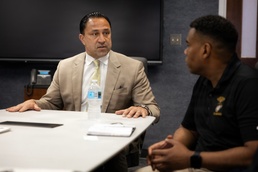
A U.S. Marine Corps leadership team visited City of Jacksonville and Jacksonville Port Authority emergency officials March 26 in Florida to strengthen coordination, improve response integration and reinforce partnerships that support military readiness.
Andre Ayoub, chief of the Jacksonville Emergency Preparedness Division, welcomed U.S. Marine Corps Col. David Merles, commanding officer of Blount Island Command and Marine Corps Support Facility Blount Island, to the city’s emergency operations center in its fire and rescue headquarters.
The center serves as the city’s central coordination point for disaster response, integrating agencies and providing a unified government voice to protect life, property and critical infrastructure.
Merles arrived with his command team and senior staff from operations, emergency management and law enforcement.
Capt. Shawn Hall of the Jacksonville Fire and Rescue Department led discussions on a range of scenarios, from countering terrorism to mitigating the impacts of hurricanes. He explained evacuation zones, shelter operations, response processes and plans, and measures to protect vulnerable populations.
The team also discussed the city’s comprehensive emergency management plan, which is routinely updated through coordination across city, county, state and federal partners.
In the afternoon, the leadership team visited the Jacksonville Port Authority security operations center, where discussions focused on port security, incident response and efforts to mitigate drone incursions.
Marine Corps Support Facility Blount Island is co-located with JAXPORT, one of Florida’s largest seaports. Blount Island’s maritime industrial base connects Northeast Florida to both military sustainment and broader global trade networks.
The engagements highlighted how local partnerships and infrastructure support broader military objectives, linking community coordination to global force readiness and sustainment.