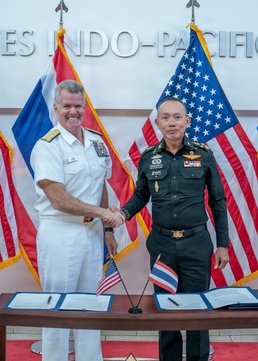
Adm. Samuel J. Paparo, commander of U.S. Indo-Pacific Command, welcomed GEN Ukris Boontanondha, Chief of Defense Forces of the Royal Thai Armed Forces, at USINDOPACOM headquarters for the 4th Senior Leaders' Dialogue on March 23-24, 2026.
Paparo and Ukris co-presided over the event, marking a significant milestone in the enduring U.S.-Thailand partnership. The leaders addressed shared challenges and reaffirmed their vision to transform the alliance through expanded military modernization, bilateral and multilateral exercises, and other mutually beneficial programs.
During the dialogue, they signed an eight-star annex, building on progress from previous Senior Leaders’ Dialogue. The annex serves as a guiding framework for RTARF and USINDOPACOM cooperation programs and activities under the Thai-American Consultations defense meeting cycle, reinforcing the alliance’s commitment to operational excellence and strategic collaboration.
The 4th Senior Leaders' Dialogue underscores the importance of the U.S.-Thailand alliance, rooted in shared values and a mutual commitment to peace and security in the Indo-Pacific region. Both sides remain dedicated to strengthening their military partnership, advancing modernization efforts, and promoting interoperability to address evolving regional challenges.
This dialogue continued the momentum from Adm. Paparo’s visit to Thailand in January, where he met with GEN Ukris to discuss shared priorities and strengthen defense cooperation.
The continued engagement between USINDOPACOM and RTARF reflects the enduring strength of the U.S.-Thailand partnership and its critical role in maintaining stability in the Indo-Pacific.
USINDOPACOM is committed to enhancing stability in the Indo-Pacific region by promoting security cooperation, encouraging peaceful development, responding to contingencies, deterring aggression, and when necessary, prevailing in conflict.