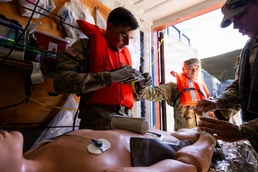
JOINT BASE PEARL HARBOR-HICKAM, Hawaii – Soldiers from the 8th Forward Resuscitative and Surgical Detachment, 18th Theater Medical Command, with support from 7th Transportation Brigade (Expeditionary), conducted littoral medical training, March 20-24, 2026, aboard a U.S. Army Maneuver Support Vessel (Light)-01. This was the culminating event in a series of exercises designed to test a critical concept: how to provide continuous care during ship-to-shore operations in an island chain environment.
U.S. Army Lt. Gen. Mary K. Izaguirre, U.S. Army surgeon general and commanding general of U.S. Army Medical Command; and Command Sgt. Maj. John Dobbins, senior enlisted advisor to the commanding general were present to observe the training. Also observing were Maj. Gen. E. Darrin Cox, 18th TMC commanding general, and Command Sgt. Maj. Jennifer Francis, senior enlisted advisor to the commanding general.
The training centered on the 8th FRSD “Revenants’” use of a standard CONEX shipping container for surgical care, which they transformed into a mobile medical facility featuring a single-bed surgery room and a single trauma bed. At sea, they simulated surgical procedures on high-fidelity mannequins, assessing the team’s proficiency and equipment functionality in a maritime environment.
The exercise highlighted 18th TMC’s ongoing experimentation efforts by integrating technology designed to improve patient tracking and care. The Revenants tested the integration of the Battlefield Assisted Trauma Distributed Observation Kit-Joint (BATDOK-J) with their existing Operational Medicine Care Delivery Platform (OPMED CDP), with the goal of documenting a patient's complete critical care journey: from initial receipt and trauma assessment, through the surgical room, and into intensive care.
The Revenants also tested the use of vehicles not typically assigned to their unit for patient transport, including a Small Multipurpose Equipment Transport (SMET)—a robotic “mule”—and Infantry Squad Vehicles (ISVs). These platforms have the potential to increase a medical team's capacity and agility during the demanding transition from sea to land.
The exercise culminated with a sea-to-shore transition at a ground landing site on Joint Base Pearl Harbor-Hickam. The unit offloaded simulated patients and equipment using the SMET and ISVs, demonstrating a continuation of care from the vessel to the shore. Lastly, the containerized surgical unit was offloaded by forklift from the vessel, showcasing its modular design and ability to be rapidly redeployed.
The capabilities tested are a crucial step in preparation for Pacific Friendship 2026, a joint exercise between the U.S. and Vietnam later this year.
Through persistent integration and joint exercises, 18th TMC provides Health System Support and Force Health Protection, ensuring a ready, forward-deployed medical force in the Indo-Pacific.