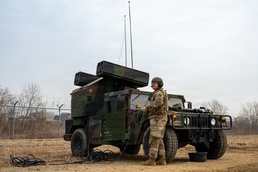
OSAN AIR BASE, Republic of Korea – The 51st Security Forces Squadron and 35th Air Defense Artillery Brigade conducted joint training during exercise Freedom Shield 26 at Osan Air Base, Republic of Korea, March 9-13, 2026.
During the exercise, the 51st SFS and 35th ADA worked together to detect and respond to a simulated hostile drone approaching the installation, using a U.S. Army AN/TWQ-1 Avenger to identify, track and engage the simulated aerial threat.
“This training integrated Army air defense capabilities into the base defense plan,” said U.S. Army 1st Lt. Ty Waits, Echo Battery, 6th Battalion, 52nd Air Defense Artillery Regiment Avenger platoon leader. “By working alongside Air Force security forces, we ensure we can rapidly respond to aerial threats and protect the installation.”
The Avenger is a mobile air defense platform equipped with Stinger missiles designed to counter low-altitude threats, such as drones and aircraft.
Integrating the Avengers system into Osan’s defensive posture strengthens the base’s layered defense strategy.
“Our goal is to defend the installation against smaller aerial threats so higher-level systems can focus on larger threats,” said U.S. Air Force Tech. Sgt. Christian Natal, 51st Security Forces Squadron noncommissioned officer in charge of wartime plans.
Natal emphasized the increasing prevalence of small unmanned aerial systems in modern conflicts, highlighting the importance that defenders train against them. Training scenarios like this ensure personnel can quickly detect, track and respond to potential unmanned aircraft incursions.
The training additionally emphasized the use of man-portable air defense teams, or MANPADs. If the Avenger platform becomes inoperable, the crews can remove the Stinger missile pods and deploy them as mobile teams capable of moving across the installation with security forces patrols.
This flexibility allows defenders to reposition quickly and maintain air defense coverage across the base.
Joint exercises like this strengthen coordination between U.S. Army and Air Force units and improve readiness against evolving threats.
“As drones and other unmanned systems become more common on the battlefield, training like this ensures we are prepared to defend the base and protect the mission,” Natal said.
“Continued joint training helps ensure forces remain ready to respond to emerging threats in a dynamic security environment."