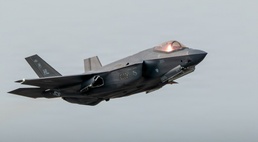
NYUTABARU AIR BASE, Japan — U.S. Air Force Airmen and Japan Air Self-Defense Force members strengthened bilateral integration and combat readiness during Nyutabaru Aviation Training Relocation exercise 26-1, at Nyutabaru Air Base, Japan, March 9 - 19, 2026.
The exercise brought together forces from the 18th Wing and JASDF’s 5th Air Wing to refine joint operations, enhance interoperability and reinforce the U.S.-Japan alliance, a cornerstone of deterrence and stability in the Indo-Pacific.
Since its inception in 2006, the Aviation Training Relocation program has played a key role in strengthening coordination between U.S. and Japanese forces. This iteration of NATR focused on integration, pairing U.S. F-35A Lightning II aircraft from the 4th Expeditionary Fighter Squadron with JASDF’s advancing fighter capability.
Operating side by side, pilots and maintainers exchanged tactics, techniques and procedures to improve their ability to generate and sustain combat airpower as a unified force.
“The level of training and integration that we are doing is very complex, and it comes at a time where the U.S. Air Force is very busy around the world,” said U.S. Air Force Capt. Harry McMahon, NATR 26-1 project officer and 4th EFS F-35A pilot. “Regardless, we are still demonstrating that in addition to being able to handle all of the ongoing missions around the world, we can still prioritize integrating and training with our valued partners
“We are committed to demonstrating that we are ready on all fronts, all of the time — that is the essence of this exercise.”
More than 150 U.S. Air Force personnel participated in the exercise, including pilots, aircraft maintainers, security forces, logistics readiness, resource management, communications and wing staff agency personnel, all working alongside their respective JASDF counterparts.
Training events included F-35A, F-35B and F-15J immersion tours, cooperative training and cross-servicing, where U.S. and Japanese maintainers marshaled one another’s aircraft, strengthening familiarity and operational coordination.
“There have been a lot of opportunities to show JASDF maintainers how we work on our jets and vice versa,” said McMahon. “Our pilots also worked closely with our fellow JASDF pilots, picking each other’s brains and learning a lot from each other — it’s been an unforgettable experience!"
U.S. and JASDF personnel also hosted members of Nyutabaru’s base cooperation committee, including local business owners and civic leaders, providing an inside look at fifth-generation capabilities and their role in regional defense.
“The 4th EFS was gracious enough to lead the group in an F-35A immersion tour,” said JASDF Capt. Suguru Shiba, 5th AW Public Affairs section chief. “We’re very pleased the U.S. Air Force provided them the opportunity to better understand the aircraft’s role in protecting the region.”
Between operations, U.S. Air Force personnel also engaged with the surrounding community, reinforcing the strong relationship between the base and local partners.
“It’s not lost on us that we are operating on a Japanese base in the Japanese countryside,” said McMahon. “Most of our folks know enough Japanese to get by, but the majority of the conversations here are happening in English, which is their second language. The level of hospitality we’ve experienced here is extremely humbling.”
Over the course of the exercise, U.S. and Japanese forces generated 42 sorties and more than 120 flight hours, demonstrating their ability to operate together in a complex and dynamic environment.
NATR 26-1 demonstrated the growing integration of U.S. and Japanese airpower and reaffirmed a shared commitment to a free and open Indo-Pacific, ensuring allied forces remain ready, credible and capable of deterring aggression and responding decisively across the region.