Let’s start with some basics, concrete versus cement. The two terms are often used interchangeably, but they shouldn’t be – and they are definitely NOT the same thing.
Cement is a powder made from limestone and clay, used as a binder. Concrete is a mixture of cement, water, sand, and aggregates such as gravel, forming a strong construction material. In short, cement is a key ingredient in concrete.
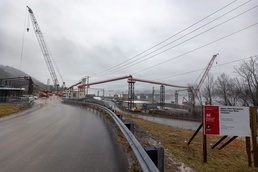
Concrete is a key ingredient in the construction of a new lock chamber at Montgomery Locks and Dam on the Ohio River.
According to Jenna Cunningham, the resident engineer for Montgomery L/D, the volume and quality of concrete required to construct the larger 600-foot-long by 110-foot-wide structure necessitate the construction of a concrete batch plant on site.
“It’s going to require around 400,000 cubic yards of concrete to build the new lock chamber, and the quality has to be strong enough to exist in river water, but to uphold the 50-year design life of the chamber,” said Cunningham.
Just to put 400,000 cubic yards in perspective -- that’s enough concrete for the foundation and structural frame for a 60 to 80-story skyscraper or concrete enough to pave a four-lane highway for approximately 15 to 20 miles. That’s roughly 560,000 tons of concrete!
Besides the volume of concrete, here’s the real reason the construction of the new chamber requires a concrete batch plant: critical infrastructure construction, such as the new lock chamber at Montgomery Lock and Dam, demands the highest standards of quality and safety. Think about it this way: that concrete will be embedded in the riverbed underwater for five decades or more.
We’re not talking about typical construction concrete.
To ensure the reliability of the concrete used in the Montgomery project, it is crucial to certify and test the concrete batch plants that produce it.
According to Mohammed Ibrahim, the chief of Construction at the U.S. Army Corps of Engineers Pittsburgh District, the onsite batch plant lab, which was certified on Feb. 5, is necessary to ensure the district is operating efficiently and to remove unnecessary red tape and the delays that would come with working with traditional commercial concrete.
“The lab is important because it will perform the primary quality assurance checks on the concrete produced by the batch plant,” said Ibrahim. “Meeting the required quality standards for the project is directly dependent on the certification and successful performance of the lab.”
At Montgomery Lock and Dam, the plant is being built to supply concrete for the new lock chamber, a vital component of the nation’s inland waterways system. The integrity of the chamber build relies deeply on the quality of the concrete used. As such, the concrete must meet strict performance specifications, including compressive strength, durability, and resistance to environmental factors like freeze-thaw cycles.
Getting the lab certified was a major milestone for the chamber construction. Getting the batch plant certified is just as important.
According to Robert “Dustin” Hacker, the materials engineering technician for the project, the final steps of the batch plant construction are to calibrate and verify it. The plant is in the process of receiving its certification.
Hacker said an inspector from the National Ready Mixed Concrete Association (NRMCA) will visit the site to verify all the equipment is “functioning within their accepted tolerance.”
“The certification process proves the batch plants are capable of operating as they’re designed to do,” said Hacker. “Once the contractor obtains the NRMCA certification, the plant can start trial batching the various types of concrete required for the project. This certification is a major milestone.”
Certification and testing of the batch plant ensure that the concrete produced consistently meets these standards.
The NRMCA certification involves verifying that the plant is properly equipped, well-maintained, and staffed by qualified personnel who understand the standards for concrete production. Testing, on the other hand, includes regular checks of the mix’s composition, as well as testing of concrete samples to confirm its strength and other critical properties.
Failure to properly certify and test the batch plant could result in the use of substandard concrete, jeopardizing the safety and longevity of the lock chamber. With such high stakes, ensuring the concrete is produced correctly is non-negotiable. Certification and testing ultimately provide confidence that the infrastructure will meet the demands of both present and future generations, ensuring safe and efficient operation for decades to come.
The qualities required for the safe and fast delivery of the chamber and the reinforcement of the Assistant Secretary of the Army (Civil Works) Telle’s initiative depend on the batch plant.
“The batch plant is integral for a couple of reasons,” said Ibrahim. “First, the speed of delivery is much faster than commercially available concrete. Secondly, the batch plant concrete specifications and quality are different than what’s available off-site.”
Therefore, the concrete batch plant is not only required, but also essential. However, it isn’t making cement.