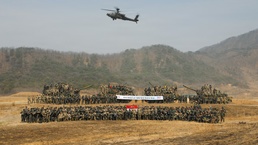
CAMP HUMPHREYS, South Korea– In a powerful demonstration of combined combat power, paratroopers from the 1st Squadron, 40th Cavalry Regiment, 11th Airborne Division, showcased the lethality and adaptability of the U.S. Army during their final major training event in the Republic of Korea. This combined arms live-fire exercise (CALFEX), held at the Yeongpyeong Training Area, was not just a training event but a clear signal of the U.S. commitment to the U.S-ROK. Alliance. It serves as a prime example of the U.S. Army's Transformation Initiative in action, delivering optimized warfighting capabilities to ensure a lethal and ready force.
The squadron’s deployment from Alaska to the Korean Peninsula highlights a force not bound by distance. As part of a larger force structure optimization, the unit is set to case its colors and reflag as the 1st Battalion, 511th Parachute Infantry Regiment in July 2026. The exercise integrated a formidable array of joint and combined forces, including the ROK Army's 8th Maneuver Division and 122nd Mechanized Battalion, the ROK Marine Corps' 73rd Airborne Battalion, and U.S. assets including the 2nd Combat Aviation Brigade's 4-2 Attack Battalion, and the 9th Engineer Support Battalion and 6th ANGLICO Company from the U.S. Marine Corps. This integration of approximately 900 U.S. and ROK service members created a cohesive, unified, and lethal fighting team, proving that combat power is not defined by size, but by capability.
Leveraging the latest technology and tactics, the allies seamlessly synchronized their operations. The training scenario began with reconnaissance drones identifying enemy positions, followed by a devastating volley of combined fires from ROK Army 81mm mortars and U.S. 60mm mortars. Simultaneously, U.S. Army Apache attack helicopters delivered precision strikes from the air, overwhelming the adversary. This multi-domain assault enabled U.S. and ROK ground forces, supported by K2 tanks and K21 infantry fighting vehicles, to close with and destroy the enemy, securing key objectives and demonstrating the agility to overcome complex obstacles like minefields with integrated engineering support.
“This is a place we don’t often get access to. We spend a lot of time specializing in Arctic warfare in Interior Alaska. But the truth is, we need to be able to go anywhere, and we’ve got a lot we can learn from our Allies here too,” said Lt. Col. Craig Nelson, the battalion commander of 1-40 CAV. This exercise validates U.S. Army’s ability to rapidly deploy combat-credible forces from the Arctic to anywhere in the Indo-Pacific, prepared to fight and win alongside our allies in any environment. It proves we are ready, anywhere and anytime.
The sentiment of partnership and mutual growth was echoed by our Korean counterparts. ROK Army Lt. Col. Kim Ye-seong, the Duko Battalion commander, stated, “We were able to conduct practical training on the key tasks that enable a mechanized unit to maneuver, survive, and innovate alongside combined assets. We will continue to do our best to establish a drone and counter-drone education and training system by deriving requirements for combat development through various realistic training exercises in the future.”
The 1-40 CAV’s final mission in Korea epitomizes the Eighth Army’s line of effort: modernizing the Alliance through readiness. By integrating latest technology applications like unmanned aerial systems and executing complex, multi-domain operations, the U.S. and ROK Alliance is actively forging a more lethal, agile, and interoperable force prepared to deter aggression and ensure stability in the Indo-Pacific region.