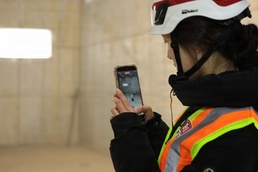
Camp Humphreys, South Korea – Capt. Rachel Lee, a U.S. Army Military Police Officer (31A), is leveraging the SkillBridge program to explore her interest in public affairs career as she transitions from military to civilian life.
She first discovered her passion for public affairs during her time in Reserve Officer Training Corps (ROTC) program, where she served as the unit’s Public Affairs Officer (PAO). When she found out about SkillBridge program, she saw it as the perfect opportunity to explore the field again. To Lee, public affairs is both a responsibility and a privilege – an effective tool to inform the public while honoring the people and organizations whose dedication drives the mission forward.
“When I was PAO, the most rewarding moments were seeing our unit receive recognition and watching the parents and families of my fellow cadets take pride in their accomplishments through the photos we shared.”
While at FED, Lee visited several project sites around Camp Humphreys, including hangars, barracks, and school, where she engaged with the teams on ground and photographed their work. She also participated in community outreach activities such as donation drive and STEAM, which were her favorite part of her time here.
Meet Capt. Lee Can you tell us about your background and what led you to join the military? LEE: I was born in Pennsylvania but grew up in South Korea. When I came back to the U.S. in high school, I stumbled upon the ROTC program. The idea of serving the community and the country really appealed to me. I've always wanted to help people, and a military career felt like honorable and effective way to do that.
What is one lesson from your time in service that you will carry with you into civilian life? LEE:The most profound lesson I'll carry with me is the unwavering commitment to the mission. I was always inspired by the resourcefulness and dedication Soldiers brought to every challenge. I intend to bring that same 'mission-first' mindset and problem-solving attitude with me.
Why did you choose to participate in the SkillBridge program, and how did you find this opportunity? LEE:I chose to participate in SkillBridge to gain real-world experience and confirm that this is the right field for me. It felt like the perfect low-risk, high-reward way to explore a new career path and apply the skills I learned in the military. I first heard about the opportunity through the Transition Assistance Program (TAP).
What drew you to the U.S. Army Corps of Engineers or this particular role for your internship? LEE:USACE’s workforce is largely civilians, so I thought there would be many opportunities. After contacting several organizations, the efficiency and positive engagement from FED were what ultimately drew me. The process was straightforward, and it was clear that FED has a strong, well-run program for SkillBridge interns, which made it my top choice.
What has your experience been like working for FED? LEE:My experience has been overwhelmingly positive. The culture at FED is incredibly welcoming; from day one, people here made an effort to introduce themselves and make me feel like part of the team. On site, I'm always treated with respect, and everyone is open to answering my questions. I've also been included in a wide range of day-to-day operations, giving me great exposure to different sides of FED's work.
How does your current role in the internship align with your long-term goals? LEE:I have always been interested in working in Public Affairs field, so this internship aligns with my long-term goal of that. This internship has been the ideal opportunity to gain foundational, real-world experience. It has given me a practical understanding of daily operations, the professional culture, and the skillsets required for this career path.
What advice would you give to those who want to participate in the SkillBridge program? LEE:I would say to be proactive. This is the perfect 'tryout' period in your desired field. It’s also important to reach out to several organizations to build your network and find the best fit. And don't forget to look into the AER grant. It provides funding for expenses such as travel and clothing, which was a nice help for me.
What’s been the most challenging part of transitioning from military to civilian work? LEE:I think the most interesting adjustment has been more cultural. In the military, you're surrounded by people who have shared experience and even a common language, where in the civilian work setting, everyone has a different background.
What has been the most rewarding part of transitioning from military to civilian work? LEE: Appreciating the experience in the military. Being part of something bigger than myself has given me a unique sense of purpose and confidence that I'm excited to apply in the civilian career.
Have your goals or vision for the future changed since starting this internship? If so, how? LEE:My perspective has definitely shifted. I came into this internship unsure about staying connected with the military, butmy time here made me realize how much I value being part of the military community.
About FED’s Role in SkillBridge The U.S. Army Corps of Engineers – Far East District is proud to offer opportunities for transitioning service members through the SkillBridge Program. FED’s focus on workforce management, engineering, construction, and planning provides interns like Lee with valuable exposure to real-world civilian work. By connecting military experience with civilian sector needs, FED helps service members like Lee build the skills necessary for their next career step.
For more information about USACE FED or the SkillBridge Program, check out the links below: