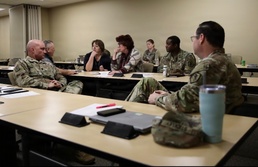
FORT KNOX, Ky – The U.S. Army Human Resources Command is conducting a large-scale mobilization exercise, or MOBEX, to test the unit’s capability to recall Soldiers, shift to a wartime posture and manage personnel readiness across the force.
The exercise supports HRC’s ongoing effort to ensure the Army sustains manpower operations during large-scale combat operations. It is intended to validate the command’s new mobilization plan and confirm its systems and processes function effectively under the pressure of national mobilization.
“This MOBEX is important for HRC because the complexities of large-scale combat operations could require alternatives to status quo manning cycles,” said Lt. Col. Daniel Trevino, a lead MOBEX planner for HRC’s Military Personnel and Resources Directorate. “By assessing our current systems and processes, we can identify ways to improve our business practices and improve our support for a more dynamic operational environment.” Matthew Peter, the lead planner for the exercise, said they want to ensure HRC can effectively support the Army’s manpower requirements during a large-scale national mobilization.
“This is the first time we are moving our new mobilization plan from paper to practice in a controlled setting rather than during a real-world crisis,” Peter said. “Our goal is to guarantee that HRC can operate at tempo when the Army needs it most.”
While HRC has conducted similar exercises in the past, this iteration is more comprehensive.
“HRC has always trained for mobilization, but this exercise is unique in its scale, scope and design,” Peter said. “It’s the first full test of our post-transformation plan, built around a deliberate structure that starts with academics, moves through internal testing and culminates in full enterprise integration.”
The MOBEX includes three major phases. Phase I, conducted in January, focused on internal coordination across HRC’s directorates.
“We spent this phase building shared understanding,” Trevino said. “Our teams discussed their respective roles, reviewed how our systems interact, and identified opportunities to streamline processes.”
Phase II occurred in March and serves as an internal stress test.
“That is where we take what we learned in Phase I and validate that our internal processes can meet operational requirements,” Peter said. “We need to be certain our own house is in order before testing across the enterprise.” The final phase, planned for August, will expand to include external partners including Headquarters, Department of the Army G-1; U.S. Army Reserve Command; Army service component commands; and others.
“Phase III is where we bring together the entire mobilization enterprise,” Peter explained. “This is where we test our ability to synchronize at scale across multiple organizations, just as we would in a real mobilization scenario.” The MOBEX directly supports Army Transformation and Readiness objectives.
“You cannot achieve transformation and readiness without Soldiers,” Trevino said. “This exercise is prompting critical discussions about how we manage personnel and sustain readiness in a modern warfighting environment.” HRC’s role in a national mobilization is central to the Army’s success.
“In a large-scale conflict, HRC’s ability to quickly distribute the right people from available manpower pools is what allows the Army to sustain the fight,” Peter said. “Manpower is a pillar of mobilization and our processes are the engine that drives it. A slow or inefficient mobilization is a strategic failure, and we have a responsibility to ensure that does not happen.”
For Trevino, the experience is both enlightening and demanding.
“My favorite part so far has been listening to [leaders share] institutional knowledge and capturing key processes that can serve as long-term organizational references,” he said. “The biggest challenge has been understanding the complexity of HRC’s internal structure and how each element contributes to supporting the Army.”
The collaboration throughout the process has been one of the most rewarding aspects of the project for Peter.
“Watching leaders from across the mobilization enterprise engage with our plan and share their challenges openly has been incredibly productive,” he said. “It showed that we are united in strengthening the Army’s personnel system to meet the demands of future operations.”
As the MOBEX continues through its phases, both planners emphasize that its success depends on shared understanding and critical thinking across the organization.
“The most important outcome I see is a deeper understanding of how complex personnel processes come together across HRC and the enterprise,” Trevino said.
One of the goals is for every participant to understand why their work matters to the Army’s strategic readiness,” Peter said.
“We want people to think critically, challenge the status quo and find better, faster ways to accomplish the mission,” he said. “That is the purpose of the MOBEX and the essence of readiness.”
Throughout the exercise, HRC is reaffirming its commitment to supporting the Army’s most important asset, its people, by ensuring that in times of crisis the personnel enterprise is ready to mobilize, synchronize and sustain the force anywhere in the world.