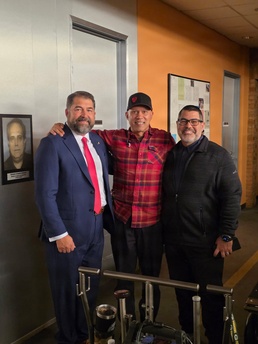
The four current television shows in CBS’ NCIS franchise—NCIS, NCIS: Origins, NCIS: Sydney, and most recently*, NCIS: Tony & Ziva*—consistently rank among the most-watched television shows in prime time. While few people had heard of NCIS before 2003 when NCIS first aired, today Special Agents rarely have to explain who they are or what they do, but no matter where they are in the world, NCIS personnel are always asked: How real is the TV show?
The dedication and teamwork reflected on the shows is genuine. NCIS Special Agents, analysts, and professionals work long hours and are driven by the desire to stop criminals and help bring justice to victims and their families. Much like the TV shows, the real NCIS workforce includes many former Sailors and Marines as well as federal, state, and local law enforcement employees from across the country. The good-natured rivalry depicted on the shows between federal government agencies—much like that between the service members of different branches of the armed services—is also true to life.
The writers and producers have taken liberties, however, on other aspects for added dramatic effect.
NCIS has a broader mission and more capabilities than are portrayed on television
Homicide investigations may make good television, but death cases make up a small percentage of the agency’s investigations, operations, and activities. It is less compelling, visually, at least, to show how NCIS protects Department of the Navy secrets and emerging warfighting technologies, how analysts obtain intelligence on terrorist activity, and how criminal investigators identify, investigate, and mitigate espionage, economic crimes, sexual assaults, illegal drugs, human trafficking, and other felony crimes.
In line with Presidential and Department of War counternarcotics and human trafficking priorities, NCIS is fighting transnational organized criminal networks on multiple fronts both at home and at sea. We continue to apply our law enforcement and intelligence capabilities to help secure the southwest border, counter narcotics and human traffickers, and strengthen the lethality and readiness of our forces in coordination with Customs and Border Protection, the Drug Enforcement Administration, and many other partners. Our field offices across the country participate in both Homeland Security Task Forces and High-Intensity Drug Trafficking Area Task Forces that combat transnational organized criminal networks engaged in narcotics and human trafficking.
NCIS Special Agents deploy globally on carrier strike groups and amphibious readiness groups for a variety of force protection and investigative missions and on Navy destroyers to provide counternarcotics and law enforcement expertise during border security operations in the Caribbean and in the Pacific.
Technologically speaking, some of the forensic tools used on the series simply don’t exist or are exaggerated for effect. Despite the lack of these cinematic shortcuts, NCIS forensic consultants remain at the forefront of their field using sophisticated 3D imaging technologies, such as the FARO terrestrial laser scanner, unmanned aerial system (UAS) imaging, and other cutting-edge technologies to bring order to often chaotic and complex crime scenes.
NCIS forensic work is a careful balance of creativity, technology, and traditional evidence collection, ensuring every scene is documented to the highest standard. Even when answers aren’t found right away, preserved evidence remains ready for future breakthroughs. Using tools like FARO, drones, virtual reality, and mobile device LiDAR (Light Detection and Ranging), paired with scientific expertise, turns even the most complex cases into successful investigations that deliver justice for victims and their families.
Another important distinction is the amount of time it takes to complete an investigation or operation. To wrap up a case in about 42 minutes, the television shows have to take liberties on the types of information NCIS has access to and how quickly that information is made available. Actual investigations are rarely wrapped up that quickly, and evidence is rarely found as easily.
NCIS actively builds relationships with domestic and foreign partners
The relationship between NCIS and law enforcement counterparts is often portrayed as competitive or antagonistic for dramatic effect. In truth, NCIS proactively builds and maintains strategic, mutually beneficial partnerships with local, state, federal, international, and foreign law enforcement and security agencies. NCIS has a global mission, so it is imperative that the agency have a network of partners around the world with a vested interest in helping to mitigate or eliminate criminal and terrorist threats to transiting Navy and Marine Corps personnel.
For instance, as the NCIS mission in Australia expands to support the trilateral AUKUS partnership, our continued engagement with Australian law enforcement and security partners remains critical to advancing shared security objectives and ensuring the safety of Department of the Navy personnel and assets. NCIS is similarly embedded with Navy, Marine Corps, Department of War, and foreign partners on joint national security and law enforcement efforts in Europe, the Middle East, the Caribbean, and around the globe.
NCIS also works closely with Navy and Marine Corps commands to identify and reduce insider threats and threats to cyber capabilities across the Department of the Navy.
These partnerships often involve subject matter expert exchanges in which NCIS provides training on enhancing security in and around ports, preserving evidence, and collecting biometrics information. NCIS has also initiated information-sharing exchanges with domestic law enforcement partners and spearheaded efforts to establish similar programs with counterpart agencies overseas.
NCIS Special Agents devote considerable time to paperwork and coordination
One aspect of being a NCIS Special Agent that the shows gloss over is the incredible amount of non-investigative work involved in resolving a case. Successful prosecutions depend on meticulous documentation of facts and supporting evidence and complying with important administrative requirements.
Special Agents and investigators spend a substantial amount of time at a desk researching and analyzing investigative information, documenting interviews, creating investigation reports, reviewing statements, drafting criminal complaints, preparing chain of custody documents, preparing affidavits, attending trainings, and testifying. They also meet with prosecutors, other law enforcement representatives, and military commands to present their cases and address issues before the cases are heard in the military justice system or a civilian court.
While the NCIS on television might be a compelling and dramatic interpretation of what goes on inside the real NCIS field offices, there is no doubt that the shows’ wide exposure to national audiences have boosted recruitment, aided agency partner efforts, and fostered broad awareness of the NCIS mission.
To learn more about the real NCIS, visit https://www.ncis.navy.mil/.