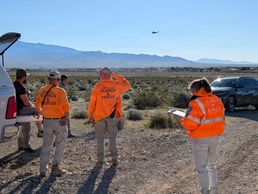
NELLIS AIR FORCE BASE, Nev.— As a pararescueman, Tech. Sgt. Daniel Peters is no stranger to early mornings. Still, the 4 a.m. phone call he received on March 3 woke him with a start.
“When it’s a phone call waking you up instead of your alarm, it’s going to be a long day,” he said.
He was right.
On the other end of the line was Peters’ division commander, Capt. John Howe, 88th Test and Evaluation Squadron combat rescue officer, with dire news.
“A Nye County hiker is stranded on Shadow Mountain,” he explained over the phone. “We gotta help.”
Almost mechanically, Peters puts on his uniform, gets ready and makes his way to base.
“When the call comes, getting up and getting moving—it may look like muscle memory, but that is years of intentional training in action,” Peters recalled. “We hold ourselves to a high standard and maintain that standard for situations like this.”
The Plan
Early March in the arid mountains of Nye County can be cold, with nights dropping into the low 40s. The aptly named Shadow Mountain presents a visibility challenge for hikers and would-be rescuers alike.
For the 88th TES’ search and rescue team, both factors would need to be thoroughly considered and overcome for the rescue to be a success.
The mission itself would be executed by a handful of the squadron’s members: Maj. Kimberly Taylor, the aircraft commander; Capt. Jake Seratte, the mission pilot; Staff Sgt. Brody Gates, the special mission aviator; and pararescuemen Master Sgt. Justin Tyler and Peters, whose previous experiences with Gates elicited a boost of confidence.
“Gates and I have been stationed together twice now and we’ve also deployed together,” Peters explained. “He’s the man.”
Lt. Col. Ryan Martelly, 88th TES director of operations, briefed the crew, explaining that the hiker had started his ascent in the evening, traversing several thousand feet up the mountain before the encroaching night prevented him from finding a safe path back down.
An attempt by the Southern Nye County Search and Rescue (SNCSAR) team to accomplish a traditional foot extraction was thwarted by the hiker’s location—a narrow out-cropping jutting from a sheer mountain face.
“The hiker had on only a T-shirt and shorts,” Martelly said. “When you’re that exposed in temperatures as low as it had gotten—about 40 degrees Fahrenheit—the threat of hypothermia is very real.”
It was then, with their options exhausted, the SNCSAR, via Nevada Emergency Management and the Air Force Rescue Coordination Center, contacted Martelly and requested support.
As high as the stakes were, though, the crew was possessed by a stoic calm.
Taylor, who along with Seratte, would need to thread the needle between piloting their helicopter close enough to the hiker to save him, yet not so close that he’d get blown off his ledge by the helicopter’s downwash, took stock of her training.
“Years of practice in diverse environments builds the critical thinking skills to execute a more complex mission, and while there may be more risk involved, it feels controlled and routine,” Taylor said. “The rescue community is built on quiet professionalism and an unwavering commitment to others. We’ll always be ready to respond for those in need.”
In addition to the rescue crew, the Squadron Aviation Resource Manager, Staff Sgt. Heather Soto, and the Aircrew Flight Equipment technician, Tech. Sgt. Natalya Perry, likewise contributed to the mission by coordinating flight authorizations and appropriately equipping the rescue crew.
After the 355th Aircraft Maintenance Squadron, who were already on 24-hour operations, cleared their HH-60W Jolly Green II for flight and all members were clear on their respective responsibilities during the mission, the rescue crew took off, heading south into the breaking day.
The Rescue
It took the crew 25 minutes to reach Shadow Mountain. In concert with the SNCSAR and the Nye County Sheriff’s Office, they were able to navigate to the hiker’s general coordinates.
Despite an increase in visibility caused by streaks of sunlight eking out over the horizon, finding the hiker still proved difficult.
“He was essentially camouflaged, wearing the same colors as the surrounding terrain,” Gates remembered.
Undeterred, the crew persevered in finding him.
Taylor and Seratte piloted the helicopter for an initial pass along the provided coordinates, all eyes peeled.
Nothing.
They turned around and attempted a second pass.
Then, barely perceptible against the rock and shadow, was the hiker. Gates spotted him and flagged him to Taylor and Seratte.
Downwash, the change in direction of air deflected by the aerodynamic action of a helicopter rotor blade in motion, is a concern for any helicopter, typically generating winds around 70 m.p.h.
The HH-60, though, generates winds up to 100 m.p.h.—more than enough to knock the hiker off his slender perch.
But Taylor and Seratte didn’t flinch.
“We prioritized lowering our altitude enough to not cause the hiker any instability,” Taylor said. “At the same time, we also wanted to establish and maintain a safe and controlled hover to make it easier for Gates and the pararescuemen to hoist him up.”
Reaching a comfortable hover height about 115 feet above the ledge, Gates prepared the hoist and began to lower Peters.
If Peters felt nervous on the descent, he gave no indication of it.
“On the hoist, all I was thinking about was making patient contact and ensuring his safety,” he said. “I noticed the terrain looked jagged with steep drops presenting another hazard for the hiker.”
Gates lowered Peters about five feet below the hiker. A quick climb up to the ledge and Peters was face to face with a shivering form clothed in a black T-shirt and shorts. Cold, but alive. Peters positioned himself between the hiker and the precipice, removing the hiker from danger.
“My name’s Brock,” Peters called over the sound of the helicopter. “I’m a pararescueman. I’m here to help.”
After a brief medical assessment to take account of any possible injuries that may hamper the hoist back up, Peters explained to the hiker what would happen next.
“He was cold,” Peters explained. “Anyone would be in those conditions, but even so, he complied well with my instructions.”
Securing the hiker to himself, Peters signaled to Gates they were ready to be hoisted up. Slowly and carefully, the two made their way into the warmth and safety of the HH-60W.
Both pararescuemen, Peters and Tyler, immediately began treating the hiker’s hypothermia and started on a comprehensive medical review. Taylor and Seratte, meanwhile, broke from their controlled hover and returned to the party of law enforcement standing by.
“We crushed it,” Peters remembered. “The only reason that a mission like this looks routine is due to the rigorous training that the whole crew does in preparation for the call. This is something that the team was well prepared for and it showed with everyone’s rapid response.”
That Others May Live
When the crew returned to base, the praise was effusive.
“Everyone called us,” Martelly said. “The Nye County Undersheriff called to express his sincere gratitude for the assistance. Their office posted a video and ‘thank you’ message on their Facebook page. Nevada Emergency Management offered thanks for our professionalism and quick response.”
It’s humbling to receive that kind of response to the work the squadron does, but at the same time, it’s not the reason these crews go out, he added.
“The motto of the U.S. Air Force’s rescue community is ‘These things we do, that others may live,’” he said. “Maintaining our proficiency and tactical prowess is essential to informing the tests and tactics that the community demands. Because we do that, our crews can be woken up in the dark hours of the morning and execute an unplanned, high skill hoist recovery when it’s required.”
Martelly himself was there to greet the crew when they landed. Upon gathering them, it was he who reminded them of that motto.
“You did a difficult thing well,” he told the crew. “Not at a moment of your choosing, but when it was needed. You recovered someone who needed help—someone who would not have received help unless we answered that call.”
Sleep-deprived and hungry, Peters persevered through the rest of the duty day, helping his team prepare for the following day’s training mission. Upon returning—finally—back home, he was greeted by a different kind of team.
“I’ve got three kids,” he laughed. “It never stops.”
And neither does he.
Tomorrow, a call may come. Another stranded hiker, an injured service member, a natural disaster.
He’ll be ready then, too.