Eleanor Prohaska, USINDOPACOM J708
CAMP JESSADA, Rayong Province, Thailand — Exercise Cobra Gold 2026 elevated realistic, combined joint all-domain training as the U.S. Indo-Pacific (INDOPACOM) J7 Pacific Multi-Domain Training and Experimentation Capability (PMTEC) delivered advanced unmanned systems, maneuvering maritime targets and integrated multi-agency support to U.S., Thai and Republic of Korea forces during a counter-landing exercise on February 28. This created a training environment that mirrored the complexity of modern conflict and strengthened coalition readiness across the Indo-Pacific.
Master Sgt. Matthew Hall, 15th Marine Expeditionary Unit assistant operations chief supporting counter-landing and amphibious operations, said PMTEC’s contributions transformed the exercise.
“These drones and everything that are coming in is putting Marines in the mindset of, ‘Instead of fighting in a 2D world, now it’s a 3D world,’” Hall said. “It forces them to think critically about threats from every direction.” PMTEC worked with the U.S. Army’s Threat Systems Management Office and Project Manager Training Devices, also known as PM TRADE, to provide high-fidelity unmanned systems that replicated the capabilities of peer adversaries, aligning with the Department of War’s theme of “lethality forged through realism.”
PMTEC coordinated maneuvering Hammerhead unmanned surface vessels to simulate an adversary amphibious assault during the counter-landing exercise.
“They were able to actually source unmanned surface vessels to simulate an actual beach assault from an adversary force,” Hall said. “It gives U.S. and coalition forces an actual target to defend against without putting strain on partner forces.”
These maritime targets forced U.S., Thai and Republic of Korea forces to detect, track and defeat a realistic, fast-moving threat, mirroring the challenges of modern littoral warfare.
PMTEC also delivered Outlaw Group 2 unmanned aircraft systems, first-person-view drones and one-way attack drones that replicated emerging aerial threats seen in contemporary conflicts.
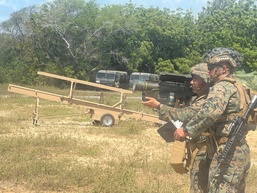
“This is the emerging threat technology around the world,” Hall said. “Getting those technologies and being able to mesh that all together on how peer adversaries would fight is what we’re trying to get after.” These systems enabled combined forces to rehearse offensive and defensive counter-UAS tactics, including tracking threat targets with the FIM-92 Stinger.
“It was probably some of the best training we could have gotten because this is a realistic situation on how drones would act, flying left to right, nose-diving toward us,” said Lance Cpl. Graham Gleaton, 1st Low Altitude Air Defense Battalion, Marine Air Control Group 18, 1st Marine Aircraft Wing. “It gave us a better gauge to see how fast and efficient we should be to activate the missile and shoot down the drone before it gets close to friendly territory.”
“You don’t get this chance every day,” said Gleaton. “This is something that we always ask for, and we finally got to do it. This is a great opportunity for our younger enlisted gunners, who get the opportunity to get that missile on their shoulder and go through the whole engagement.”
Thai Royal Navy Cmdr. Weerakamon Suanchan, 1st Artillery Battalion officer in charge of the counter-landing exercise, said the high-threat targets made the training more realistic. According to Suanchan, training alongside U.S. and Republic of Korea Marines in a realistic environment was “awesome.”
“What we can share here is better than reading about it in a book or doctrine online,” Suanchan said. Hall echoed that sentiment saying that PMTEC’s contributions ensured every participating nation trained to the same high standard.
“It doesn’t matter which country you’re from — we’re all here for the same reason,” Hall said. “If we all have the same threat picture and can share the same TTPs (tactics, techniques and procedures) and SOPs (standard operating procedures), it’s only going to make us stronger.”