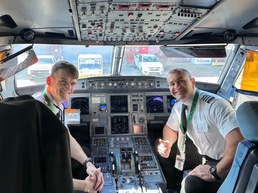
Chief Warrant Officer 2 Ryan Jones and Warrant Officer 1 Austin Scales serve as UH-60 Black Hawk helicopter pilots for the Georgia Army National Guard. While that is a profound accomplishment on its own, both soldiers have also leveraged their military careers to create opportunities for success as civilian pilots.
Jones is an instructor pilot and Scales is an aviation safety officer. While their standard National Guard training missions might include weaving above the treetops of the North Georgia Mountains at 120 knots, their full-time jobs as commercial airline pilots have them gliding above the clouds, navigating international airspace at 30,000 feet. After three years flying for Frontier Airlines, they both credit the Georgia National Guard for the opportunity.
“Since the Georgia Guard sent me to flight school, I was able to obtain my Restricted Airline Transport Pilot Certification (R-ATP) quicker than others outside the military trying to go to the airlines,” said Scales. He admits the learning curve was steep, since he had to learn new systems, switches, and standard operating procedures. “I relied on the healthy study habits that got me through Army flight school to carry me through my airline training”.
Jones’ learning curve was inverted, since he had to adjust from fixed-wing experience to rotary-wing training. “I started flying planes when I was 15 and already had 100 hours in light airplanes before I went to Army flight school, said Jones. “So, there was a bigger curve to learning helicopters then there was transitioning to jets.”
Both pilots began their military service as commissioned officers, a path that traditionally leads to command and staff positions with diminishing flight time. Preferring to focus on flying, both Jones and Scales made the career decision to transfer to the warrant officer corps, where they now serve as subject matter experts in the field of aviation.
“I realized that I was spending more time away from the cockpit and aviation related activities than I wanted to,” said Scales, who has over eight years of service. “I joined up to fly and there is nothing else I’d rather do.”
Jones, who has served the Georgia Guard for 15 years, shared this priority. After a successful company command, he chose a path that would keep him flying while allowing more time with his family. "My brigade commander and I decided that I would serve more purpose to the organization as a pilot," he said.
While both commissioned and warrant officers serve in leadership roles, Scales and Jones weighed the differences in rank and pay, accepting a reduction in both to achieve their goals.
“Most people think the challenge of the transition would be leaving a position of authority or leadership and having those you once led, be in charge of you,” said Scales. “In my opinion, being a good leader or follower isn’t tied to a specific rank or role.”
With their own career paths successfully charted, the focus for both pilots has shifted toward the next generation. As an instructor pilot, Jones is now training and certifying new aviators, fulfilling a long-term goal.
Scales recommends that aspiring pilots explore military scholarship opportunities through the National Guard to fund their journey to the cockpit. For those inspired to follow in their footsteps, he offers direct advice on the personal commitment required.
“Study hard, network, continuously learn, and enjoy every second of flying,” said Scales. “The road to becoming both an Army aviator and airline pilot is a long process. It won’t happen overnight, and it is a grind. The memories, experiences, certifications, and friends I’ve made in both careers have made everything worth it.”