FORT WAINWRIGHT, Alaska — An assignment in Alaska offers unmatched scenery and outdoor adventure, but the extreme cold, extended darkness and geographic isolation can challenge the quality of life for Soldiers, civilians and their families.
To help overcome those challenges, Sgt. 1st Class Jullian Hodges, former first sergeant for Medical Department Activity – Alaska assigned to Bassett Army Community Hospital, helped establish the Outdoor Mentorship program, an initiative designed to build resilience and community by connecting people with the Alaskan environment and each other.
Launched in October 2024, the program provides hands-on instruction in outdoor skills that allow participants to safely explore and enjoy life in interior Alaska.
“Outdoor Mentorship is led by volunteers who want to pass on their knowledge of how to enjoy the environment we live in,” Hodges said. “This can be a hard place to live if you stay inside and isolate yourself.”
The idea for the program took shape shortly after Hodges assumed duties as first sergeant. He organized an outdoor gathering for barracks Soldiers, complete with food, music and games, but only five people attended.
“All they had to do was walk outside their barracks,” Hodges said. “Instead, they stayed in their rooms, and that concerned me, especially knowing how isolation affects mental health.”
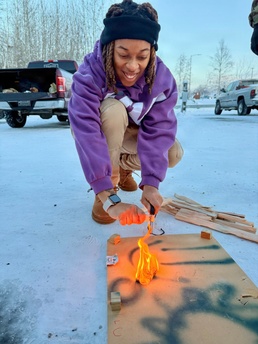
Hodges and a group of mentors developed the program as they went to reduce fear and inexperience by offering guided instruction in activities unique to Alaska. Events include topics such as ice fishing, big-game hunting, gardening, gold panning and primitive fire-starting.
The program, open to all MEDDAC-AK personnel, including Soldiers, family members and civilian employees, doesn’t track success by attendance alone but also focuses on personal growth and confidence.
"You see them open their eyes to the things that they can do, you see that light come on and they're like, 'Oh man, I can really do this,'" Hodges said.
Spc. Javaun Murray, an orthopedic technician at Bassett ACH, experienced that firsthand. Originally from Jamaica, Murray had never gone fishing before participating in an Outdoor Mentorship ice fishing event in 2024. “I was nervous when they started drilling holes in the ice,” Murray said sheepishly. “Once I realized we weren’t going to fall through, I was fine.”
Murray caught several fish during the event and later organized his own fishing trip with fellow Soldiers.
“When I got back to the barracks, I told other Soldiers how much fun it was,” he said. “We rented equipment from Outdoor Recreation so we could go on our own, and I was able to teach them what I learned.”
According to Hodges, that confidence directly contributes to quality of life. “Quality of life isn’t just about housing or amenities like shopping,” Hodges said. “It’s about how you interact with your environment and the people around you.”
That impact was evident during a recent “Ice Fishing with Santa” event, where 35 participants braved temperatures near minus 30 degrees. Despite the cold, attendees shared laughter, caught fish and built connections.
“If you can get out and smile, even when it’s minus 40, that’s a good thing,” Hodges said.
The program also strengthens unit cohesion by providing opportunities for bonding outside the workplace.
“It gives junior Soldiers a chance to interact with leaders as people, not just as rank,” Hodges said. “Those relationships build trust and improve morale.”
Hodges noted that while Fort Wainwright’s Outdoor Recreation programs offer valuable resources, the Outdoor Mentorship program fills a gap for medical personnel whose 24/7 mission limits their ability to attend scheduled classes.
By operating within the unit and leveraging volunteer expertise, the program offers flexible opportunities tailored to the MEDDAC-AK mission.
“This program wouldn’t work without the mentors who volunteer their time and equipment,” Hodges said. “They bring what they have to help others get started.”
At its core, the Outdoor Mentorship program encourages personnel to embrace the unique opportunity of serving in Alaska. “People save their whole lives to come here on vacation,” Hodges said. “We’re paid to be here, so take advantage of it.”
Through shared experiences and outdoor education, the program continues to build resilience, strengthen connections and ensure members of the MEDDAC-AK community make the most of their time in the Last Frontier.