Nobody grows up dreaming of a career in electronic warfare.
But for three days in March, nearly 500 scientists, engineers, military officers and industry leaders from three nations filled the base theater at Naval Base Ventura County Point Mugu to discuss how to win an invisible fight that could decide the next war.
The 53rd Collaborative Electronic Warfare Symposium, held March 10-12, brought participants from the United States, Australia and the United Kingdom together for classified sessions focused on "massed electromagnetic warfare." The concept: concentrate electronic warfare effects from multiple nations' platforms to overwhelm an adversary's radars, communications and defenses simultaneously.
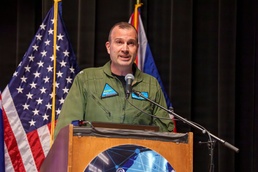
Capt. Jon Rugg, vice commander of Naval Air Warfare Center Weapons Division, opened the symposium by framing three challenges facing the coalition.
Adversaries are building adaptive, AI-enabled networks to target allied forces. The acquisition process moves too slowly for a digital-age conflict. And the future demands distributed, coordinated effects across manned and unmanned systems from multiple nations.
"An 80% solution in the fleet today is infinitely more valuable than a 100% solution on a PowerPoint slide a year from now," Rugg said.
Rugg invoked the Chief of Naval Operations' three priorities: the Fleet, the Foundry and the Fight. The Fleet is the deployed force. The Fight is the high-end conflict the Navy must be ready to win. The Foundry is the scientists, engineers and industry partners who build the tools of victory.
"Look around this room. We are the Foundry," Rugg told the audience.
The symposium exists because no single organization can solve the problem alone, or without allied partners.
Even within the U.S. military, electronic warfare systems across the services were not built to coordinate with each other in real time. Sharing threat data, synchronizing jamming and updating mission plans across platforms midflight remains a work in progress.
Adding Australian and British systems with different data standards and classification rules makes the challenge harder. In a conflict, coalition forces will not have time to work around those gaps.
Mark Threadgold, chief of electromagnetic warfare at the United Kingdom's Defence Science and Technology Laboratory, said the AUKUS EW partnership addresses that gap directly.
"Pooling our AUKUS resources to deliver against common aims is allowing us to accelerate EW capabilities to the warfighter in a way that could not be achieved as individual nations," Threadgold said.
The symposium began decades ago as a U.S.-only event. Australia joined as a partner years later. The United Kingdom attended for the first time in 2025, making this year the second as a full trilateral.
The event operates under the auspices of the AUKUS Pillar II Electronic Warfare Working Group (EWWG) Terms-of-Reference, which focuses on advancing shared EW technologies and capabilities across the three nations.
It is the largest classified conference hosted by the Association of Old Crows, a nonprofit professional association that serves the global electromagnetic spectrum operations community.
The first day ran at the U.S. Secret level. The following two days opened to all three nations at Secret Releasable to AUKUS.
Shelley Frost, executive director of the Association of Old Crows, said that classification level makes the event distinct.
"The classification level allows for genuine collaboration to be possible," Frost said. "Given the events in Ukraine, Venezuela and now Iran, the urgency behind those conversations has never been greater."
Naval Air Warfare Center Weapons Division co-hosts the symposium and provides the technical backbone for much of the coalition's integration work.
Point Mugu has served as the center of U.S. Navy airborne electronic warfare since 1951, when pioneers first challenged the assumption that the electromagnetic spectrum should be ceded to the enemy without a fight.
Today, NAWCWD manages laboratories and the 36,000-square-mile Point Mugu Sea Range, covering electronic warfare, artificial intelligence, autonomous systems and platform integration.
Gerardo Garcia, director of NAWCWD's Spectrum Warfare Department, said the symposium reflects the command's core mission.
"Our goal is to discuss, discover, and provide integrated and interoperable warfighting capabilities through cutting-edge research and development to provide warfighters a decisive advantage,” Garcia said.
In practice, massed EW means building the systems, standards and processes that allow coalition platforms to coordinate effects across an entire theater.
If allied forces need to penetrate an integrated air defense, massed EW would require multiple nations' assets to simultaneously block satellite communications, jam radar signals and disrupt GPS. That coordination has to happen in real time, across platforms that were never designed to talk to each other.
Anthony Schellhase, program lead for electromagnetic warfare at Australia's Defence Science and Technology Group, said the annual event allows Australia, the U.K and the U.S to share classified threat and capability information, receive updates on national programs and priorities, and importantly "nurture and mature AUKUS EW relationships" across the coalition.
Threadgold put it simply: "Classified EW conferences are rare. International classified EW conferences are even rarer."
The symposium's agenda reflected where the coalition is headed. Sessions covered AI-enabled electronic warfare, swarming and expendable systems, synthetic testing of multinational layered operations and low-cost electronic attack for survivability in high-intensity conflict.
Presenters included researchers from all three nations alongside industry partners. The mix of government, academia and industry is by design. Past symposiums have connected small businesses with programs that needed their technology, turning a conference presentation into a fielded capability.
Rugg ended his opening remarks with a challenge that applied to every person in the room, from every nation.
"We will not win by building a single, perfect weapon. We will win by building a lethal, resilient, and adaptive ecosystem, powered by our most valuable resource: the unique, passionate, problem-solving people in this room."