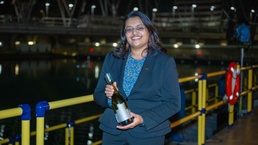
BETHESDA, Md. – For Anindita Mukherjee, creativity and technical precision have never been separate pursuits. At Naval Surface Warfare Center, Carderock Division, they finally meet in the same work.
Mukherjee didn’t set out to work in naval engineering. As an aerospace engineering student at the University of Michigan, her focus was on space systems: satellites, rockets, and problems far beyond the ocean.
Carderock wasn’t part of the plan when she attended a career fair.
“I made eye contact with the right recruiter,” she said. “I had a lovely on-site interview and then I ended up here.” What started as an unplanned step turned into a role that fits more naturally than she expected.
“I think it’s a job that I always wanted but didn’t know,” she said. “I knew I wanted something hands-on. I knew I wanted a very collaborative environment where I got to use my creativity. I just never thought it would be here.”
Mukherjee joined Carderock in 2020, initially supporting ship structural modeling and simulation. The work focused on understanding how structures behave over time. She evaluated strength, damage, and performance through digital models.
Her work today reflects a different pace and level of engagement.
As part of the Manufacturing of Attritable Systems at Scale (MASS) team, Mukherjee contributes to the design and development of rapidly produced systems designed for flexibility and use in operational environments. The team’s work emphasizes speed, accessibility, and the ability to manufacture closer to the point of need.
For Mukherjee, the shift is both immediate and tangible.
“It’s really rewarding to see something that I generated and designed and talked about with my coworkers actually being built by me,” she said. “It’s like your baby.”
That pace is matched by how the team operates, relying on close collaboration, quick feedback, and shared space to move ideas forward.
“Being so immediate with one another, we’re able to innovate much more quickly,” she said.
That same instinct to build, iterate, and visualize has been with her much longer than her engineering career. Outside of work, Mukherjee practices paper quilling, a form of art that transforms thin strips of paper into intricate, layered designs. The process is detailed and repetitive, requiring both planning and patience.
“I was always an artist as a kid,” Mukherjee said.
Recently, she completed a two-foot by three-foot quilled map inspired by “Avatar: The Last Airbender,” a project that took thousands of individual pieces to complete.
Mukherjee describes being an artist as “a very foundational part” of who she is. Her creative work doesn’t sit separate from her technical work. It informs how she approaches both design and problem-solving.
That influence shows up in how she communicates complex ideas. In one project, she used her artistic skill to map and visualize technical information for inspectors, making it easier to interpret and act on.
“It’s interesting the things that I can help visualize and communicate to other people using my artistic skills that are already there,” she said.
That combination came into focus in a recent project that connected her work back to her alma mater.
Mukherjee designed a custom vessel wrap for the University of Michigan’s Mixing of the Waters ceremony, incorporating the skyline of Carderock’s historic David Taylor Model Basin. The piece will remain on permanent display at the university.
Seeing the finished product, and her name on it, marked a shift. It reflected her growth as both an engineer and a professional.
“I’m so, so proud,” she said. “I’m proud to take ownership of it, which is something I’ve been learning how to do.” Asked what she would tell someone still figuring out their path, Mukherjee kept it simple.
“Do what you love,” she said. “Keep looking for what will make you happy.”
Mukherjee’s path didn’t follow a straight line, but it led her to a space where the things she’s always been drawn to – building, designing and creating – support one another.
At Carderock, she didn’t have to choose between being creative and being technical. She just had to recognize they were the same thing.