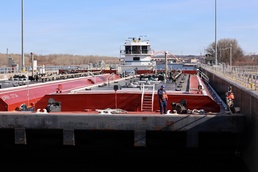
ST. PAUL, Minn. – The first tows of the 2026 Upper Mississippi River navigation season arrived in St. Paul, Minnesota, Monday, March 23.
Corps of Engineers staff locked the Motor Vessel Crockett through Lock and Dam 2, in Hastings, Minnesota, late in the afternoon with two barges en route to St. Paul. She was immediately followed by four additional tows. The lockages mark the unofficial start to the navigation season because the lock and dam is the last one before reaching St. Paul. Ice in Lake Pepin, near Red Wing, Minnesota, traditionally prevents tows from heading upstream earlier than March.
The average first tow arrives around the third week in March. The Motor Vessel Neil N. Diehl was the first tow of the 2025 navigation season to reach St. Paul. She arrived March 20, 2025. The earliest date for a tow to reach St. Paul occurred March 4. It happened in 1983, 1984 and 2000.
With the head of navigation open, the U.S. Army Corps of Engineers’ Mississippi River navigation mission will continue to provide safe, reliable and cost-effective waterborne transportation for products such as crops, fuels and materials. Within the Upper Midwest, the St. Paul District maintains the Mississippi River 9-foot navigation channel and operates 12 locks and dams to support river traffic from the Twin Cities to Guttenberg, Iowa.
Keeping this system open is vital to the nation’s economy. A 15-barge tow is the equivalent to more than 1,050 semi-trailers or 200 rail cars. One barge can carry more than 50,000 bushels of wheat, or enough to make around 2.1 million loaves of bread. A barge filled with 50,000 bushels of corn can produce around 1.3 million boxes of cereal. Shipping these commodities on the river saves money and ultimately helps to reduce costs at the grocery store.
-30-