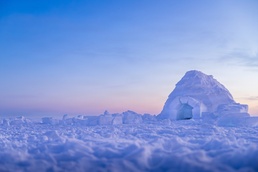
POINT BARROW, Alaska - Recently 17 Survival, Evasion, Resistance, and Escape (SERE) specialists from the Department of the Air Force (DAF) completed Journeyman Arctic Survival Training (JAST), at Point Barrow, Alaska, the northernmost point in the United States.
The five-day training conducted by the DAF Arctic Survival School, 66th Training Detachment 1, immersed the SERE specialists in extreme arctic conditions to hone their abilities to survive and operate in a part of the planet where nature is ruthless.
“This training is a critical step for our SERE specialists to achieve their 5-level journeyman qualification,” said Lt. Col. Gordon Blair, 66th Training Detachment 1 commander. “It’s not just a box to check; it’s ensuring they have the specialized skills to survive and aid in recovery of isolated personnel in the unforgiving arctic environment.”
The Airmen were pushed to their limits while practicing essential survival skills that included constructing various snow shelters like igloos and snow caves, while also mastering essential techniques for sustenance, health and signaling while operating in the frozen, barren wilderness.
“You can read about building a snow cave from a book, but it's a completely different world when you are doing it for real in negative 49-degree temperatures while the wind is howling,” said Staff Sgt. Dillion Dastrup, 66th TRS Detachment 1 arctic survival instructor. “Every skill we have learned is put to the test here and you realize very quickly that efficiency and attention to detail are what will keep you alive when the temperature starts to drop.”
Point Barrow, also known as Utqiaġvik, lies within the Arctic Circle and experiences periods of 24-hour darkness during the winter, which made it the perfect location for this intense arctic training.
“Operating in constant darkness is as much a mental game as it is a physical one,” said Staff Sgt. Joseph Kloss, 66th TRS Detachment 1 arctic survival instructor. “It messes with your perception of time and can be disorienting. You have to trust you're training and your team. It will force you to be more deliberate in your actions as well as maintain constant communication.”
One of the crucial elements of this training's success is owed to the partnership with the Ukpeaġvik Iñupiat Corporation (UIC), the Alaska Native village corporation for Utqiaġvik. The UIC provides logistics support that makes the mission possible by lending their deep expertise and knowledge of the region.
“Our partnership with the Ukpeaġvik Iñupiat Corporation is essential to this training,” said Blair. “Their logistical support is indispensable, but more than that it’s the generational knowledge of this land that is something you can never get from a manual. They are true partners in our mission.”
A unique aspect of the training is a cultural day where students have the opportunity to learn directly from the Iñupiat people, gaining a broader perspective and appreciation for the Arctic and what it takes to survive. This immersion allows them to understand the cultural values and practices that enabled the Iñupiat to thrive in such a harsh region for thousands of years.
“The cultural day was fascinating and insightful,” said Senior Airman Dalton Billings, 66th TRS Detachment 1 Arctic survival instructor. “Being able to learn about the Iñupiat people, and their resourcefulness and deep respect for the environment gave us a new perspective on what it means to be in harmony with the landscape, and what it takes to live here.”
The impact of this specialized training was further highlighted by the presence of leadership from the 19th Air Force, 336th Training Group, 58th Special Operations Wing, and the 354th Fighter Wing.
“The overall presence of leadership from across the Air Force underscores the strategic importance of the Arctic,” said Blair. “Having them there, seeing the training firsthand, sends a very clear message that what our SERE specialists are doing is critical to national security, and displays our ability to operate in any environment around the globe.”
The completion of the JAST course marks a major step in these specialists’ careers, adding the Arctic to an already impressive resume that has seen them accomplish training in many environments.
“Our students have been through temperate, desert, and open-ocean survival training, but the Arctic is an entirely different beast,” said Master Sgt. Kevin Zamora, 66th TRS Detachment 1 senior enlisted leader. “The cold is a constant, relentless adversary and completing this course is a huge milestone for them. It’s the final piece of the puzzle in becoming a well-rounded SERE specialist, and it gives them the confidence they need to be able to train others.”
This advanced training held near the Arctic Circle, where the sun never reaches beyond the horizon and the cold never relents, ensures these individuals are more than prepared and capable to adapt, overcome and survive in any situation or potential isolation incident within the Arctic, fulfilling global mission readiness standard that leaves no room for error.