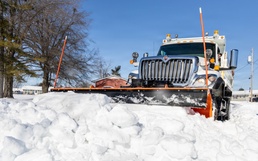
Fort Knox, Ky. – Just over six weeks ago, the greater Fort Knox community found itself buried in roughly 6-8 inches of snow and ice, leading to days of disruptions to installation operations.
While spring is arriving, Fort Knox officials continue to refine winter weather delay and closure plans and processes.
When winter weather strikes, the installation’s workforce and parents await notifications from installation and school officials regarding potential work/school delays or closures. The decisions, however, are more complex than simply looking out the window. They involve a multitude of factors that balance mission readiness with safety.
One of the most common misconceptions, according to Fort Knox Installation Protection Branch Plans and Operations Chief Chad Westcott, is the sheer number of variables considered before a weather call is made.
“The weather itself is obviously the primary factor, and by extension, the ability of the workforce to commute safely,” said Westcott. “There are also factors less visible to the public, such as ongoing installation missions and missions supported by Fort Knox units and organizations occurring across the world. Additionally, we’re considering capabilities to treat and clear roads as well as the precautions our neighboring communities are taking.”
Delay, closure or early release:
Westcott said the decision to implement a delay versus a closure depends on the storm’s timing and severity. A delay is typically used for less severe weather that has short-term impacts.
“Weather delays play an important role in reducing risk,” said Westcott. “They give our crews more time to clear and treat roads and parking lots while limiting commuter traffic. Additionally, it moves the commuting window of most of the community to daylight hours, which increases visibility.”
A closure, on the other hand, is considered when significant accumulation is expected overnight. However, Westcott emphasized that the installation is rarely, if ever, completely closed. This is why community members may notice new vernacular going forward, such as “open with restrictions.”
“There are always a variety of missions that continue operating regardless of the weather,” he said. “A better way to frame a closure is that the installation’s senior commander authorizes tenant unit and organization commanders to reduce staff by maximizing telework or allowing non-essential staff to stay home.”
Westcott added that in situations where the installation is “open with restrictions,” public messaging will always explain what those restrictions are so people have a clear understanding of available installation services.
Another lesser used option, according to Westcott, is an early release, which is intended to be “phased” based on commuting distance. When road conditions are expected to deteriorate in the afternoon, the intent is to release workforce personnel with the farthest commutes first to limit traffic congestion and promote safety.
Above all, Westcott stressed the importance of employees contacting their supervisors when they are unsure how to proceed.
“Every commander on the installation has the authority to make workforce decisions based on mission needs during a closure,” said Westcott. So, when an employee sees a message about delay, early release or closure, they should either already know their work section’s policy or contact their supervisor for specific guidance.
How the installation and schools differ:
The call to close or delay Fort Knox Community Schools comes from the Department of War Education Activity, not installation officials.
According to Westcott, installation representatives may offer suggestions based on a given weather situation, but the operational needs and risk tolerances are different.
“School closures are obviously a factor in installation decision making because we understand the concern over childcare when schools are closed,” said Westcott. “However, there are a lot of installation missions that must continue regardless of the school’s weather call.”
Westcott said it’s often the case that Fort Knox Community Schools make decisions counter to weather calls made by the installation or the surrounding school districts.
“When it comes to children walking to and being transported to school in icy conditions, it’s understandable that DoWEA has a more stringent risk tolerance than the installation,” said Westcott. “Conversely, FKCS may be open or delayed when off-post schools are closed because they do not have to consider bus routes in rural and remote areas like the surrounding counties.”
Clearing the way:
Once a storm hits, snow and ice removal operations begin based on a strict prioritization list.
According to Westcott, roads and gates are always first. Next are mission essential functions like Police, Fire and EMS as well as units and organizations supporting global Army missions with 24/7 operations. From there, crews work through other services and the nearly 500 parking lots across the installation.
However, according to Directorate of Public Works Operations chief Jay Schmidt, community members should understand that Fort Knox is simply not equipped or staffed for major snow events in the same way as installations in colder climates, like Fort Drum, New York.
He added that challenges like equipment breakdowns, extreme temperatures, and the type of precipitation can significantly impact timelines.
“Brine and salt tend to lose their effectiveness below about 10-15 degrees Fahrenheit, depending on the wind chill,” said Schmidt. “To further complicate matters, crews deal with equipment breaking or clogging on hard ice, visibility issues, and continued thawing and refreezing that negates some of the road clearing operations already completed. The more time crews have to complete their work without people on the roads, or in parking lots, the better.”
For these reasons, Schmidt stressed the importance of staying off the roads for those who aren’t required to physically come into work.
“The single most important thing that the community can do to help is to simply stay off the roads,” said Schmidt.
“This one action has the most significant positive impact on our ability to manage a winter weather event and directly correlates to the safety of the entire community.”
Community roles:
According to Schmidt, clearing the installation is a shared responsibility. For instance, DPW is responsible for cantonment and range area roads, while Knox Hills is charged with addressing the roads within the housing areas. However, housing residents also play a part.
“Tenants are expected to clear the sidewalks in and around their particular set of quarters as well as driveways if they have them,” said Fort Knox Deputy Housing Chief Chuck Waters.
According to Schmidt, building managers and tenants also have a critical role to play in maintaining safety.
“The prompt and thorough reporting of facility damage by building managers, especially during a weather event, is not just a procedural task,” said Schmidt; “it is a critical component of maintaining operational readiness.”
Waters added: “These inspections often result in finding small problems that, if reported promptly, can be fixed before they become much larger problems.”
Community members can also assist by reporting hazardous conditions and maintenance concerns. “If the issue is in the housing area, they can report the concern through the resident portal at http://www.knoxhills.com,” said Waters. “Outside of housing, they should contact the Fort Knox Directorate of Emergency Services.”
When it comes to road clearing operations in neighborhoods, Westcott encouraged tenants to assist Knox Hills by following any instructions sent to residents.
“Knox Hills will send messages out to residents asking them to assist with road clearing operations by parking on the same side of any given street or in a designed area,” said Westcott. “Cooperating is extremely helpful, and residents should accommodate these requests if possible.”
When it comes to providing feedback, positive and constructive input are welcome. During a storm, the most helpful information is real-time, actionable intelligence.
“Letting DES know a specific location of a downed tree or powerline or a particularly bad patch of ice is absolutely helpful,” Westcott said. “After normal operations resume, broader feedback on things like communication clarity and route priorities helps officials improve future operations.”
Ultimately, navigating a severe winter weather event at Fort Knox requires planning, patience and partnership from the entire community to keep essential missions going because, as Westcott stated:
“Our adversaries across the globe simply do not care if it snows at Fort Knox.”