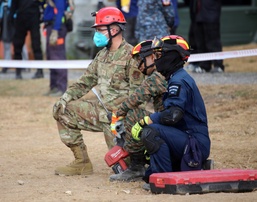
Halfway around the planet in the Indo-Pacific, Soldiers and Airmen from the Washington National Guard’s 10th Homeland Response Force arrived at Phanom Sarakham District prepared to respond to a simulated disaster alongside international partners during Exercise Cobra Gold 2026 in Thailand.
U.S. Air Force Maj. Aaron Meredith observed the Washington National Guard’s role in Cobra Gold unfold from several echelons – as the planning officer for the 10th HRF, the director of operation for the 194th Civil Engineer Flight, and as a civil engineer officer supporting the urban search and rescue operations during the exercise.
“The 194th Civil Engineer Flight has the emergency management function at Camp Murray, a CBRN readiness mission, and engineering officers,” said Meredith. “When you look at the 10th HRF’s capabilities, it ties in pretty closely.”
The 10th HRF is primarily tasked with responding to chemical, biological, radiological and nuclear incidents in the United States, but at its core, its mission is saving lives and mitigating suffering in the wake of disaster.
“Scenarios we typically prepare for back home are usually CBRN responses,” Meredith said. “But in reality, we could be responding to any kind of hazard.”
That overlap made Cobra Gold’s humanitarian assistance and disaster relief training a natural extension of the unit’s mission.
“At its core, they’re exactly the same mission,” Meredith said. “That’s why it makes sense for us to support an exercise like this.”
The training scenarios during the exercise reflected real-world risks in the Indo-Pacific region, including widespread flooding in northern Thailand and a simulated tsunami impacting the south. For members of the 10th HRF, the scenarios closely mirrored disasters they have responded to at home, including flooding in Washington state just months prior.
Beyond technical training, the opportunity to strengthen relationships during Cobra Gold proved equally valuable.
“It helps build out the state partnership with Thailand,” Meredith said. “It allows our professionals to share their experience with our partners and also learn from them.”
Thailand brought both civilian and military responders to the exercise. Each brought their own expertise to the exchange, particularly in urban search and rescue operations.
“We were able to spend a lot of time interacting with them and learning from their techniques,” Meredith said.
That partnership is part of a broader, long-standing relationship. The Washington National Guard has worked alongside Thailand through the State Partnership Program since 2002, making exercises like Cobra Gold a valuable opportunity for continued cooperation.
For U.S. Army Lt. Col. Taihei Hongo, chief of staff for the 10th HRF, the value of participating goes beyond the immediate training.
“Right now, the HRF is technically not able to support overseas missions,” Hongo said. “But the more we demonstrate our capabilities in environments like this, the more it opens the door for future opportunities.”
Hongo emphasized that expanding the HRF’s visibility helps reinforce its relevance, not just at home, but globally.
“Most people don’t know about us, or only see us as a ‘break glass in case of emergency’ type of unit,” he said. “Anywhere we can show our value and build multinational interest benefits the organization as a whole.”
That relevance extends directly to the broader Chemical, Biological, Radiological and Nuclear Response Enterprise.
“The HADR mission ties directly to domestic operations,” Hongo said. “It helps partner nations develop their own internal response while reinforcing that our mission applies beyond just the homeland.”
Whether in Washington state or abroad, the 10th HRF mission doesn’t change.
Be ready. Mitigate suffering. Save lives