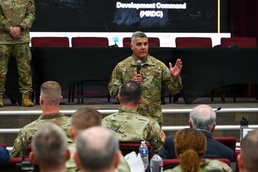
JOINT BASE SAN ANTONIO— Senior Army leaders, medical professionals, and defense industry partners convened at the U.S. Army Medical Center of Excellence from March 10-12 for the 2026 Medical Warfighting Forum. This annual event, co-hosted with U.S. Army Medical Research and Development Command, focuses on transformation and strengthening medical readiness across the force.
The event brought together representatives from the U.S. Army and joint medical enterprise to discuss lessons learned, modernization initiatives, and the future of medical support in large-scale and complex operational environments.
Maj. Gen. Anthony L. McQueen, MEDCoE commanding general and Joint Base San Antonio Senior Army Element Command emphasized his daily mantra that set the stage for the focus of the forum.
“The two questions I look at each day as I walk into my office are: Are we getting after it from a training aspect, and are we getting after it from a capabilities standpoint and delivering what’s expected of us?” The next three days would examine those two questions from multiple perspectives, across multiple specialties and disciplines within the Army and joint services.
The forum opened with discussions of strategic guidance and current trends. Senior leaders provided updates on Army Medicine priorities, modernization initiatives, and organizational transformation. Sessions examined operational lessons-learned, including insights from recent deployments and observations from combat training centers. Discussions also explored the requirements of large-scale combat operations.
Day 2 focused on theater Medical Support, Point of Injury to Role 3 Care, also called in-theater hospitalization. Participants examined casualty statistics, timelines of evacuation, and the effectiveness of current medical support structures across Roles 1, 2, and 3. Scenario-based discussions highlighted operational challenges, opportunities for improved coordination, and ways to enhance medical readiness. The day also emphasized intratheater convalescent care and the importance of integrating medical capabilities.
The forum concluded on Day 3 with discussions about innovation, integration, and unified effort, highlighting advancements in medical research, operational medicine systems, and logistics transformation. Sessions also addressed emerging technologies, forward presence in support of global operations, and the integration of human performance science to optimize Soldier readiness in extreme environments.
Additional discussions examined modernization of medical information systems, improvements in casualty care for future conflicts, and the impact of broader Army transformation initiatives on medical logistics and operational support.
Over the course of the three-day event, participants shared best practices, identified capability gaps, and collaborated on solutions to ensure Army Medicine remains prepared to deliver responsive and effective medical support across military operations.
“It is our responsibility to give our Army medics, physicians, nurses, the best opportunity to save lives on the battlefield, whether that is resourcing them with people, equipment, or training,” McQueen said.