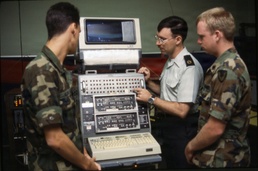
In March 1985, all soldiers in the U.S. Army’s Career Management Field (CMF) 33 were awarded one of five new military occupational specialties (MOSs). This was not the first restructuring of the electronic maintenance field, but it was more complex and far-reaching than changes in the CMF up to that time.
The CMF 33 was created in 1965 when four long-standing intercept equipment maintenance specialties were combined and redesignated as CMF 33 MOSs. Further revisions led to an entry-level 33B MOS to feed personnel into four functionally aligned specialties—33C Receivers, 33D Recorders, 33F Demultiplexers, and 33G Electronic Countermeasures/Directional Finding—and, then, just a few years later, the deletion of that 33B MOS in favor of a new Basic Electronic Maintenance Course as the prerequisite for entry into other 33 MOS-producing courses. Soon, the Army found itself unable to fill intelligence units with maintenance personnel holding the necessary MOSs, leading CMF 33 soldiers to work outside their specialties.
In 1975, the Army Security Agency Training Center and School (ASATC&S) at Fort Devens, Massachusetts, which had proponency for CMF 33, combined all 33 MOSs into a single 33S Electronic Warfare (EW)/Intercept Systems Repairer MOS. This “super mechanic” would be “the best trained electronic technician the Army had to offer… qualified to work on all types of equipment in strategic and tactical environments.” Paired with this effort, the ASATC&S developed a new entry-level course augmented by Additional Skill Identifier (ASI) functional courses to train 33S soldiers to work on specific equipment.
Unfortunately, the influx of emerging electronic technologies for the new Combat Electronic Warfare and Intelligence (CEWI) divisions exacerbated problems in CMF 33. Within just a few years, 33S soldiers could obtain more than thirteen ASIs qualifying them to work on 2,500 diverse pieces of electronic equipment. No Skill Qualification Test could measure proficiency on all the available systems. Retention rates began to fall as 33S soldiers became overwhelmed by their responsibilities and realized how lucrative their skills could be in the civilian sector.
Hungry for a better solution, in late 1979, the U.S. Army Intelligence School, Devens (USAISD), successor to the ASATC&S, contracted with a private company for an occupational job and task analysis of CMF 33. Two years later, personnel from national-level organizations and Army commands around the world evaluated the contractor’s three proposals. The preferred proposal broke the 33S back into four entry-level MOSs driven by the types of EW/Intercept equipment the soldiers would repair. Two of the new MOSs were tactical (mobile)—33R Aviation Systems and 33T Tactical Systems—and three were strategic (fixed)—33P Strategic Receiving Subsystems, 33Q Strategic Processing/Storage Subsystems, and 33M Strategic System Analyst and Command and Control Subsystems. The 33M was a merger MOS at grade E-5 (sergeant). The supervisory MOS (33Z) was retained. U.S. Army Intelligence Center and School Cmd. Sgt. Maj. Sammy Wise at Fort Huachuca promised, “Each [MOS] now has a more distinct and attainable mission.” Existing 33S soldiers would be evaluated on their experience, training, preference, present assignment and, of course, “the needs of the Army,” to determine their new MOS.
In October 1982, USAISD stood up a task force of 33S soldiers, warrant officers, education specialists, and civilian and military clerical support to tackle this daunting restructure while continuing to maintain 33S training. The Army’s deputy chief of staff for personnel approved the restructure on Jan. 5, 1984. Meanwhile, the real work was ongoing. CW2 Richard Bottis outlined that the revision required the development of “eight programs of instruction; 1,400 lesson plans; tests; student handouts; 17 skill qualification tests; and associated soldiers’ manuals, job books and training guides.” Much of this work had been completed by October 1984, when the USAISD Maintenance Training Department piloted the new entry-level courses.
In March 1985, all 33S personnel were reclassified into their new MOSs under this latest CMF 33 restructure. Although proponents recognized it was “not the ultimate solution to the problem,” they anticipated it would lead to increased proficiency, job satisfaction, and retention.
Article by Lori S. Stewart, USAICoE Command Historian. New issues of This Week in MI History are published each week. To report story errors, ask questions, request previous articles, or be added to our distribution list, please contact: TR-ICoE-Command-Historian@army.mil.