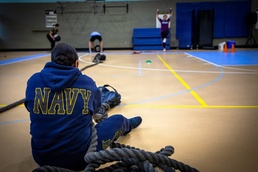
A Sailor grips the edge of a stretcher as the ship shifts beneath them, boots pounding across the deck while intercom updates cut through the noise. Every movement is deliberate. In these moments, outcomes depend not just on medical knowledge, but on physical readiness. When the call comes, there is no pause, only execution.
Across the Fleet, scenarios like this are not hypothetical. They are expected, inevitable. For Naval Medical Forces Atlantic, physical fitness is not a personal goal. It is a requirement that directly impacts operational readiness, survivability, and the ability to deliver expeditionary medical care in contested and austere environments.
Corpsmen are expected to move with speed, carry weight, and sustain performance under pressure. Whether operating aboard ships, supporting Marines in the field, or responding during mass casualty events, physical conditioning directly affects how quickly and effectively care can be delivered.
“Maintaining a high level of physical fitness is vital for operational and medical readiness,” said Hospital Corpsman 1st Class Morgan Critchfield, a command fitness leader (CFL) and general duty corpsman assigned to Naval Medical Forces Atlantic (NMFL). “If you’re out of shape, you can’t perform well. You’re more likely to get hurt or not be a full member of the team which puts the mission at risk.”
That gap in performance has consequences beyond the individual. It affects timelines, increases risk, and places additional strain on already limited resources in high-demand environments.
“Physical fitness puts you in a position to be an asset instead of a liability,” said Hospital Corpsman 3rd Class Paul Cormier, an assistant CFL and general duty corpsman assigned to NMFL. “Victory loves preparation. If you prepare yourself for the worst and you’re consistent with it, you don’t have to hope for the best because the best outcome will be handed to you.”
For expeditionary medicine, preparation is not theoretical. It is built through repetition, conditioning, and consistency long before deployment. Strength, endurance, and mobility are not separate from medical capability. They are part of it.
Consistent training also reduces the risk of injury and medical disqualification. Physical readiness supports long-term deployability by strengthening the body against the cumulative demands of service. Routine fitness assessments further reinforce this by identifying negative trends early, allowing intervention before readiness is degraded.
Despite its importance, maintaining fitness remains a challenge across the force. Operational tempo, workload, and competing priorities often limit time and consistency. Leaders emphasize that the solution lies in sustainable habits, not complexity.
“You can have countless ideas about the physique you want or the goals you hope to achieve in your training—but without action, they remain nothing more than ideas,” said Cormier. “Just start and stay consistent. There is no single starting point and no finish line. The more you overthink it, the more it holds you back.”
Physical readiness also supports cognitive performance under stress. In high-pressure environments, fatigue can slow reaction time, reduce clarity, and impact decision-making. Conditioning the body helps stabilize those effects, allowing Sailors to think clearly and act decisively when it matters most.
“You’re not going to perform your job effectively if you’re not mentally and physically ready,” said Critchfield. “It doesn’t have to be complicated. Build simple habits, stay consistent, and make it part of your routine so you can show up ready to do your job.”
That expectation reflects a broader standard across Naval Medical Forces Atlantic. Readiness is not situational. It is continuous. It is built daily through disciplined training and reinforced through leadership, accountability, and culture.
Philosopher Socrates once wrote, “No one has the right to be an amateur in the matter of physical training.” For today’s force, that principle aligns directly with mission requirements. Physical preparedness is not optional. It is tied to the ability to respond, to endure, and to deliver care when conditions are at their worst.
As Naval Medical Forces Atlantic continues to support fleet and expeditionary operations, physical readiness remains a foundational component of mission capability. The ability to move, to lift, to think, and to act under pressure determines not just individual performance, but the effectiveness of the entire team.
“Your personal fitness directly affects the mission,” said Critchfield. “If you take care of yourself, you’re taking care of your team and the job.”
When the moment comes, there is no time to build readiness.
It must already be there.