FORT HOOD, Texas – For decades, the Army’s medical supply chain operated in its own world, a complex and often-isolated system separate from the way the force managed other commodities.
But a massive, multi-year transformation known as Medical Logistics in Campaigning, or MiC, is changing that, and a recent strategic offsite to usher in “Wave 3” of the initiative brought together experts from across the enterprise who say the effort has now reached a “tipping point” for the better as momentum builds around the new way forward throughout the force.
The goal of MiC, an enterprise-wide effort led by U.S. Army Medical Logistics Command, is to pull medical logistics out of its legacy “stovepipe” and fully integrate it into Global Combat Support System-Army, the Army’s sustainment system of record. A major subordinate command to U.S. Army Communications-Electronics Command, AMLC is charged with overseeing this complex transformation.
By aligning medical materiel with all other classes of supply, the effort is designed to enhance visibility, improve efficiency and, ultimately, boost readiness for the future fight.
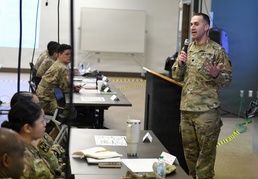
“If America goes to war, this corps goes to war,” said British Army Maj. Gen. Andy Cox, the deputy commanding general for support of III Armored Corps based at Fort Hood, in his opening remarks.
The entire MiC effort, Cox explained, is designed to give Soldiers on the front lines confidence that they will be supported by world-class health care, allowing them to execute their mission objectives without hesitation.
The current system and supporting personnel for medical materiel, also known as Class VIII, simply were not sufficient to sustain future operations as the Army undergoes drastic transformation to become a more agile, lethal fighting force.
“As we fight in a large-scale combat operation, one MEDLOG company is not going to be enough,” said Maj. Helen Daniels, corps medical logistics officer for III Armored Corps. “Using the [Supply Support Activity] as a combat enabler to ensure medical materiel gets pushed out to forward lines is really critical to make sure we have the required Class VIII to treat those casualties on the battlefield.”
For years, integration was a primary challenge. Medical and traditional logistics personnel often worked in different systems with little shared visibility, a problem Chief Warrant Officer 2 Kiptiatu Koroma, an SSA materiel manager with the 101st Airborne Division, saw firsthand.
“We all have what’s important for us and we never really thought about how it affects the other side,” Koroma said. “We’ve always looked at it from the lens of our foxhole and not the other side of what we do.”
That is precisely what MiC is designed to fix. By bringing medical supply into GCSS-Army, the initiative provides a shared, transparent view of the supply chain.
“For GCSS-Army, it brings visibility. Before we converted, you couldn’t see each other’s systems,” Koroma said. “Now, it gives a visible report. It tells commanders, ‘Hey, this part is here in this SSA.’ It opens that real-time visibility. I can see it and you can see it.”
Attended by dozens of MEDLOG professionals across the force, the offsite served as a crucial after-action review of the recently completed “Wave 2” of implementation, while setting the conditions and way-forward for the much larger “Wave 3,” which will onboard nearly 800 units around the globe – more than the first two waves combined.
A key takeaway from the event, according to MiC leaders, was the remarkable resilience and determination shown across the force. Despite a steeper-than-expected learning curve and other significant challenges, the consensus was that momentum is positive.
“The success is that the units and leaders are charging forward despite the gaps,” said Lt. Col. Travis Helm, director of AMLC’s Strategic Initiatives Group. “They accept that it's a difficult problem set to overcome, but generally they are enthusiastic and positive about moving forward.”
A standout success from the first two waves, as noted by the group, is the establishment of Forward Repair Activity-Medical, or FRA-M, sites, which bring expert medical maintenance technicians closer to the units they support.
Since the initial launch in October 2024, the first site at Fort Bragg, North Carolina, has completed nearly 2,200 work orders, servicing vital equipment for units without their own organic maintainers. Now, new sites are being setup at Fort Campbell, Kentucky, and Joint Base Lewis-McChord, Washington, with others to follow in future waves.
“We’re very excited for the Forward Repair Activity to be established,” said Capt. Nella Chipchase, division MEDLOG planner for the 101st Airborne Division. “It just closes that gap and it’s great to have that resource for reach-back.”
For Soldiers in units with limited maintenance experience and capabilities, the benefits of FRA-M support can be immense for unit readiness.
“Having that senior expertise close by is really, really critical,” said Daniels, noting that many new maintenance Soldiers are fresh from the schoolhouse and the environment can be quite challenging. “To have someone there to work with you, provide over-the-shoulder training … it’s very important.”
Despite the successes of the initial waves, MiC leaders acknowledged ongoing and significant challenges of the transition. Units have wrestled with long lead times for parts, frustrating order cancellations and cumbersome processes for ordering uncatalogued items.
The solution, echoed throughout the event, is multi-faceted, requiring leadership emphasis on the new processes and expanded training – online, internal at the unit and through local troop schools.
AMLC Commander Col. Deon Maxwell reminded those in attendance that “we must train as we fight,” adding that there won’t be brick-and-mortar medical treatment facilities in theater to provide Class VIII support.
“We’re only going to be as successful as this is emphasized by sustainment and medical leaders,” Helm said. “Without that, it will be lower on the priority list and we run the risk of failure.”
That emphasis is paying dividends at the unit level, where innovative “train-the-trainer” models are taking hold. At Fort Campbell, for example, medical logisticians (68J) have trained supply specialists (92A) about medical materiel, while those same 92As provided insight to 68Js on the intricacies of GCSS-Army.
“All it takes is one. If you can train one Soldier correctly, you can train an entire formation,” Koroma said, stressing the power of peer-to-peer training.
This integration is also changing the culture of Army logistics. For the first time, traditional logisticians are gaining a deep understanding of the medical commodity.
“We have the same maintenance capabilities [as other commodities], but they have no expertise for understanding our commodity because we’ve been so insulated,” said Maj. Travis Belobrajdic, a sustainment brigade medical logistics officer within the 1st Infantry Division. “By having us tied in now … it’s now becoming part of routine operations.”
The offsite left attendees feeling that their feedback was not only heard but acted upon, a sign that the enterprise is adapting as it moves forward.
“It has been very helpful to communicate our needs to AMLC and the CECOM [Integrated Logistics Support Center] and to see those suggestions put into action,” Chipchase said. “This success proves that every person in the MEDLOG in Campaigning initiative should feel empowered to speak up and have their concerns addressed.”
With Wave 3 implementation now underway, leaders are confident that while the work is difficult, the positive momentum and collaborative spirit will carry the initiative forward, forging a stronger, more resilient, and fully integrated medical logistics enterprise for the future.
Reflecting on the three-day event, Helm said the most encouraging sign was the shared commitment from the field to tackle the challenge head-on.
“I was pleasantly surprised by the positive tone that a lot of people have,” Helm said. “They accept that it’s a difficult problem set to overcome, but generally they are enthusiastic and positive about moving forward and making change.
“That's a wonderful environment to be in and it proves we have a good understanding of the strategic gaps and, more importantly, the path we need to take to close them.”