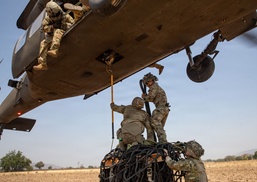
LOPBURI, Thailand - U.S. Army Soldiers assigned to the 5th Battalion, 20th Infantry Regiment, 1-2 Stryker Brigade Combat Team, 7th Infantry Division, worked with the Royal Thai Army to navigate airspace, and the U.S. Army 2nd Battalion, 158th Assault Helicopter Battalion, 16th Combat Aviation Brigade, for aircraft movements, to execute controlled sling load exercises using UH-60 Black Hawks during Hanuman Guardian, March 16, 2026.
Sling load operations are critical maneuvers that allow troops to rapidly transport supplies, equipment and vehicles into tactical environments using air support when land movements would hinder the mission. The practice typically uses UH-60 Black Hawks or CH-47 Chinooks to transfer the equipment externally using a lifting sling. The aviation unit communicates with forces on the ground to navigate unhooking or loading the freight from the hovering aircraft.
“This is basically showing that we can actually do it. We can actually go anywhere in the world and supply ourselves and sustain ourselves… wherever we're at,” explains U.S. Army Staff Sgt. Brian Cheverez, senior mechanic with the 5 - 20th. “We can actually distribute our supplies and be successful.”
Coordinating through foreign airspace is equally important. Training events like Hanuman Guardian allows allies to familiarize themselves with operations, share techniques and standardize procedures so when operating during a real-world event the movement will be seamless.
“We typically coordinate with the Thai and the U.S. users to manage airspace and work in cooperation,” said Maj. Sharon Wheelock, Task Force Tigershark operations officer, 16th Combat Aviation Brigade. “It’s beneficial for developing the systems, processes and terminology to be able to safely integrate all the air users.”
Multi-national coordination of tactical military movements create a powerful advantage for sustained readiness that will benefit allies no matter where they find themselves engaged.
Hanuman Guardian is a bilateral training exercise between the U.S. Army and the Royal Thai Army in the Kingdom of Thailand. Now in its 17th year, the exercise enhances readiness through realistic training while reinforcing the enduring U.S.–Thailand alliance, one of America’s oldest partnerships, dating back to 1833, and a shared commitment to a free and open Indo-Pacific. (U.S. Army Reserve article by Staff Sgt. Tamie Norris)